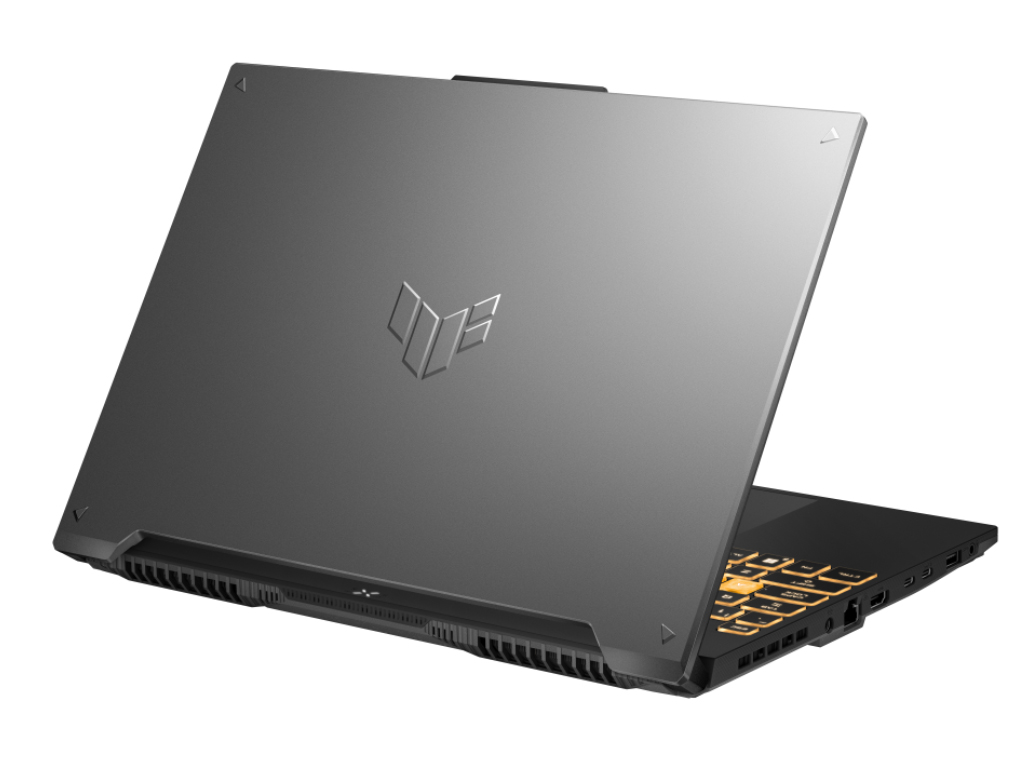




Asus TUF Gaming F16 FX607VJ
Ausstattung / Datenblatt
Preisvergleich
Durchschnitt von 2 Bewertungen (aus 2 Tests)
Testberichte für das Asus TUF Gaming F16 FX607VJ
Quelle: 91mobiles
 EN→DE
EN→DEAs per ASUS, there is a continuous demand for entry-to-mid level gaming laptops in the Indian market. While that makes the trimmed-down TUF Gaming F16 a welcome addition, it is positioned in a very awkward spot. The company launched the laptop at a very similar price as its fairly new Gaming V16, at Rs 80,990 only to eventually cut it down to Rs 76,990. Now that’s telling something. On its own, the laptop should be good for most of your daily tasks, including video playback and streaming, school or office work, and even some basic multimedia editing. The GPU is quite underwhelming and will be a lot more suitable for esports titles rather than games with demanding visuals. In comparison, the Acer Nitro V and even the ASUS Gaming V16 seem to offer a much better package, although the latter is priced a tad bit higher at Rs 82,990.
Einzeltest, online verfügbar, Mittel, Datum: 25.03.2025
Bewertung: Gesamt: 65% Leistung: 65% Bildschirm: 70% Mobilität: 50% Gehäuse: 75%
Quelle: Think Digit
EN→DEIn conclusion, the ASUS TUF Gaming F16 (2025) stands out with its sturdy design, immersive display, and decent single-core performance, making it a reliable option for casual gamers and everyday users. However, it clearly falls behind competitors like the Lenovo LOQ 15IRH8 and Gigabyte G6X in both CPU multi-threaded tasks and GPU-intensive gaming, primarily due to its dated RTX 3050 GPU and DDR4 memory. While it holds up for lighter workloads and esports titles, those seeking high-performance gaming or future-proof specs will find better value in similarly priced alternatives equipped with newer-generation hardware.
Einzeltest, online verfügbar, Kurz, Datum: 23.03.2025
Bewertung: Gesamt: 71% Preis: 78% Leistung: 53% Gehäuse: 75%
Kommentar
NVIDIA GeForce RTX 3050 A Laptop GPU: Mobile Gaming-Grafikkarte die wahrscheinlich auf den AD106 oder AD107 Chip (aktuelle Ada Lovelace Architektur der 4000er Serie) basiert. Bietet 1.792 GPU Kerne und ist in 35 - 50 Watt mit 4 GB GDDR6 (64-Bit Interface) erhältlich.
Diese Klasse ist noch durchaus fähig neueste Spiele flüssig darzustellen, nur nicht mehr mit allen Details und in hohen Auflösungen. Besonders anspruchsvolle Spiele laufen nur in minimalen Detailstufen, wodurch die grafische Qualität oft deutlich leidet. Diese Klasse ist nur noch für Gelegenheitsspieler empfehlenswert. Der Stromverbrauch von modernen Grafikkarten in dieser Klasse ist dafür geringer und erlaubt auch bessere Akkulaufzeiten.
» Weitere Informationen gibt es in unserem Notebook-Grafikkartenvergleich und der Benchmarkliste.
Core 5 210H: Auf der Alder-Lake-Architektur basierender Mittelklasse Mobilprozessor. Bietet 4 Performance-Kerne und 4 Effizienzkerne und kann 12 Threads gleichzeitig bearbeiten. Der maximale Turbo-Takt der P-Kerne beträgt 4,8 GHz. Im Vergleich zum älteren i5-13420H, bietet der Core 5 210H einen um 200 MHz höheren Boost-Takt.» Weitere Infos gibt es in unserem Prozessorvergleich Vergleich mobiler Prozessoren und der Prozessoren Benchmarkliste .
 Als bevorzugte Quelle auf Google hinzufügen