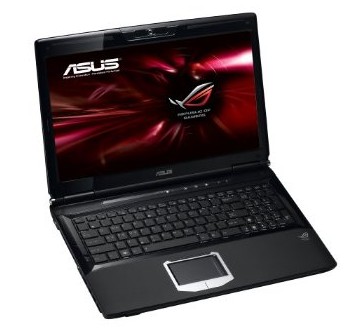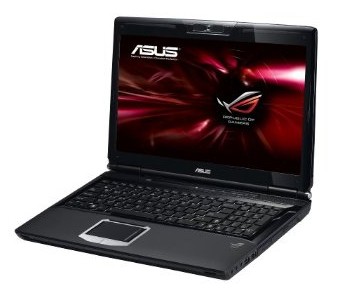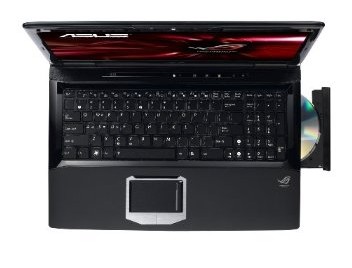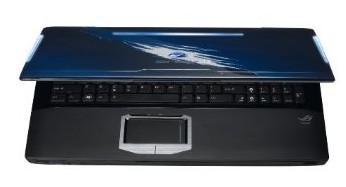




Asus G51J-3D
Ausstattung / Datenblatt

Preisvergleich
Durchschnitt von 10 Bewertungen (aus 10 Tests)
Testberichte für das Asus G51J-3D
Quelle: Good Gear Guide
 EN→DE Archive.org version
The ASUS G51J is a pricey 3D notebook that's aimed at gamers. While the ASUS G51J won't appeal to many users, and it may even miss the mark when it comes to gamers who want to be early adopters of 3D technology — it could definitely use more graphics grunt under the hood in order to compete with other dedicated gaming machines on the market, especially considering its asking price.
Einzeltest, online verfügbar, Mittel, Datum: 18.11.2010
Bewertung: Gesamt: 50%
Quelle: IT Reviews
EN→DE Archive.org versionAnyone who visited the Gadget Show at the NEC this year will know that much of the event was obsessed with showing off all the latest 3D computer technology in the wake of the massive success of Avatar. 2010 has become 3D Year and all the major computer manufacturers are jumping on board the supposed gravy train: the ASUS G51J 3D notebook is simply the latest evolution.
Einzeltest, online verfügbar, Sehr kurz, Datum: 09.11.2010
Bewertung: Gesamt: 90% Leistung: 90%
Quelle: Digital Versus
EN→DE Archive.org versionAsus continues its progress on the laptop PC gamer market and certainly isn't afraid to innovate. The G51J 3D shows that 3D can also get mobile. This technology gets it a fifth star in our rating. The results are convincing and performances are up to standard. We can't wait for a version with a better screen and faster graphics card for 3D. And why not a 17.3 inch model?
Einzeltest, online verfügbar, Mittel, Datum: 25.10.2010
Bewertung: Gesamt: 100%
Quelle: Digital Versus
EN→DE Archive.org versionAsus continues its progress on the laptop PC gamer market and certainly isn't afraid to innovate. The G51J 3D shows that 3D can also get mobile. This technology gets it a fifth star in our rating. The results are convincing and performances are up to standard. We can't wait for a version with a better screen and faster graphics card for 3D. And why not a 17.3 inch model?
Einzeltest, online verfügbar, Mittel, Datum: 30.04.2010
Bewertung: Gesamt: 100% Leistung: 90% Bildschirm: 60% Mobilität: 40% Gehäuse: 80%
Quelle: PC Pro
EN→DE Archive.org versionThe 3D craze has broken free of its early-adopter shackles, thanks in no small part to the huge success of Avatar, and manufacturers are stepping up their assault on the tech-savvy public. This model of the Asus G51J is the first 3D Vision laptop, and comes complete with the necessary glasses and transceiver in the box. The 3D effect is better than ever, but building it into a 15.6in laptop creates more than a few issues.
Einzeltest, online verfügbar, Mittel, Datum: 19.03.2010
Bewertung: Gesamt: 67% Preis: 50% Leistung: 83%
Quelle: Digital Trends
EN→DE Archive.org versionStereoscopic viewing is mere months away from exploding—or seeping, depending on one’s level of zeal and optimism—into our living rooms via new 3-D televisions from mainstream manufacturers like Sony and Panasonic. The first laptop to incorporate Nvidia’s 3D Vision technology, Asus’ G51J 3D, is a stereoscopic gaming powerhouse.
Einzeltest, online verfügbar, Lang, Datum: 11.03.2010
Bewertung: Gesamt: 70%
Quelle: Reg Hardware
EN→DE Archive.org versionAs far as 3D goes, the Asus G51J 3D is certainly a more capable machine than Acer’s 5738DZG. Not only is it more powerful, but with the active glasses it can also deliver a better 3D experience. The high price tag is the obvious stumbling block. Prices will no doubt fall if and when 3D finally takes off, but at the moment anyone looking to wave goodbye to 2D will have to pay a rather hefty premium.
Einzeltest, online verfügbar, Lang, Datum: 28.01.2010
Bewertung: Gesamt: 70%
Quelle: CNet
EN→DE Archive.org versionNvidia's 3D Vision technology renders most games in pretty impressive 3D, but it requires an investment in compatible hardware, including a 120Hz LCD monitor, approved desktop GPU with dual-link DVI connection, and a pair of battery-powered 3D glasses with a USB infrared emitter. The Asus G51J 3D is the first laptop to incorporate Nvidia's 3D Vision technology. If you absolutely love the idea of 3D gaming, this proof-of-concept system will work well as a pricey showpiece.
Einzeltest, online verfügbar, Mittel, Datum: 20.01.2010
Bewertung: Gesamt: 79%
Quelle: CNet
EN→DE Archive.org versionWe've been very impressed with Nvidia's 3D Vision technology, which renders most games in pretty impressive 3D, but it requires an investment in compatible hardware, including a 120Hz LCD monitor, approved desktop GPU with dual-link DVI connection, and a pair of battery powered 3D glasses with a USB IR emitter. The Asus G51J-3D is the first laptop to incorporate Nvidia's 3D vision technology. If you absolutely love the idea of 3D gaming, this proof-of-concept system will work well for a pricey showpiece.
Einzeltest, online verfügbar, Mittel, Datum: 15.12.2009
Bewertung: Gesamt: 75% Leistung: 90% Ausstattung: 90% Mobilität: 40%
Quelle: Laptop Mag
EN→DE Archive.org versionThe ASUS G51J 3D is an exciting notebook for early adopters who want to take their gameplay to the next level. While we would’ve liked a higher-resolution screen—and higher frame rates—this rig is more than capable of playing the latest titles. At $1,699, it’s $200 more expensive than the non-3D version, but that premium is reasonable considering the newness of the technology. Acer’s $779 Aspire 5738DG does a better job of bringing 2D movies into the third dimension, but Nvidia’s 3D technology is more effective, and provides better viewing angles with the included glasses. If you’re a gamer, the G51J 3D is definitely worth a look.
Einzeltest, online verfügbar, Lang, Datum: 01.12.2009
Bewertung: Gesamt: 70%
Kommentar
NVIDIA GeForce GTX 260M: Die GeForce GTX 260M basiert auf den G92b Chip und ist daher mit der 9800M GTX verwandt (und nicht wie der Name vermuten lässt mit der Desktop GTX 260). Im Vergleich zur 9800M GTX wird die GTX 260M in 55nm produziert und höher getaktet.
Diese Klasse ist noch durchaus fähig neueste Spiele flüssig darzustellen, nur nicht mehr mit allen Details und in hohen Auflösungen. Besonders anspruchsvolle Spiele laufen nur in minimalen Detailstufen, wodurch die grafische Qualität oft deutlich leidet. Diese Klasse ist nur noch für Gelegenheitsspieler empfehlenswert. Der Stromverbrauch von modernen Grafikkarten in dieser Klasse ist dafür geringer und erlaubt auch bessere Akkulaufzeiten.
» Weitere Informationen gibt es in unserem Notebook-Grafikkartenvergleich und der Benchmarkliste.
720QM: Der Core i7-720QM war zur Zeit der Einführung der langsamste Core i7-9xx Quad Core Prozessor. Er taktet dank Turbo Modus automatisch zwischen 1.6-2.8 GHz. Außerdem unterstützt er Hyperthreading zur gleichzeitigen Abarbeitung von 8 Threads. Im Vergleich zu den stärkeren Core i7 bietet er außerdem nur 6MB L3 Cache.» Weitere Infos gibt es in unserem Prozessorvergleich Vergleich mobiler Prozessoren und der Prozessoren Benchmarkliste .
 Als bevorzugte Quelle auf Google hinzufügen