




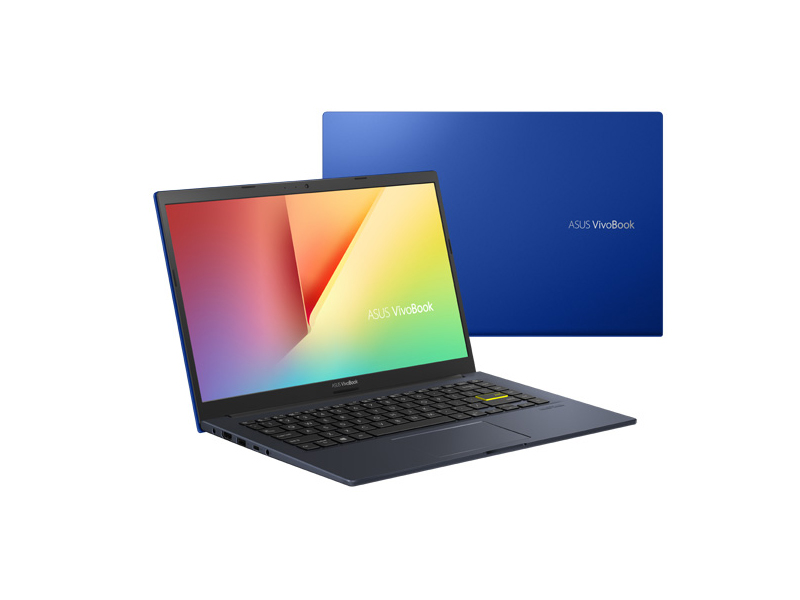
Asus VivoBook 14 A413, i5-10210U MX330
Ausstattung / Datenblatt
Preisvergleich
Durchschnitt von 3 Bewertungen (aus 4 Tests)
Testberichte für das Asus VivoBook 14 A413, i5-10210U MX330
Quelle: KL Gadget Guy
 EN→DE Archive.org version
For RM2,899, the ASUS VivoBook 14 does a lot well, particularly in the battery department; unfortunately, its low RAM capacity holds back what the laptop could be capable off with its Intel Core i5-10210U CPU and NVIDIA MX330 GPU. Perhaps for a more well-rounded alternative, I’d say go for the HONOR MagicBook 14, which is cheaper at RM2,299 while offering 8GB RAM, and a capable AMD Ryzen 5 3500U. On the other hand, if you need something great to type on, is super lightweight, has great audio, plus support for Wi-Fi 6 – the VivoBook 14 is a good pick. Visit ASUS’s website here to learn more purchase the laptop.
Einzeltest, online verfügbar, Lang, Datum: 23.10.2020
Bewertung: Gesamt: 70%
Quelle: Hitech Century
EN→DE Archive.org versionThe ASUS VivoBook 14 A413 is an entry level 14-inch ultraportable with specifications sufficient for everyday general computing with fair performance in all areas. You’re getting a workhorse that can get your coursework done, your spreadsheets and emails sorted and let you browse the web, catch Netflix and otherwise stay connected in the new normal.
Einzeltest, online verfügbar, Lang, Datum: 21.09.2020
Bewertung: Gesamt: 70% Preis: 70% Leistung: 70% Bildschirm: 70% Mobilität: 60% Gehäuse: 70%
Quelle: NLT
EN→DE Archive.org versionPersonally, I’ll suggest you to add RM300 more and get the VivoBook S15 S533 instead at RM3,199. That laptop comes with an IPS LCD screen, better build quality, and 8GB RAM – but also soldered and also MX250 instead of MX330.
Einzeltest, online verfügbar, Mittel, Datum: 21.09.2020
Quelle: Pokde
EN→DE Archive.org versionThe ASUS VivoBook 14 A413 looks like a promising ultraportable productivity laptop at first glance. You get a 10th Gen Intel Core CPU with MX330 discrete GPU, 512GB NVMe SSD, Wi-Fi 6, and good looks at a rather affordable price.
Einzeltest, online verfügbar, Sehr Lang, Datum: 21.09.2020
Bewertung: Gesamt: 72% Preis: 65% Leistung: 65% Mobilität: 85% Gehäuse: 85%
Kommentar
NVIDIA GeForce MX330: Wahrscheinlich auf die alte GeForce MX150 / MX250 basierende Notebook-Grafikkarte (mobile Version der GT 1030). Eventuell beim Speicherbus und den Taktraten beschnitten. Wie bei der MX250 können auch wieder zwei Varianten zum Einsatz kommen (normale mit 25 Watt und langsamere Stromsparvariante mit 10 Watt).
Diese Klasse ist noch durchaus fähig neueste Spiele flüssig darzustellen, nur nicht mehr mit allen Details und in hohen Auflösungen. Besonders anspruchsvolle Spiele laufen nur in minimalen Detailstufen, wodurch die grafische Qualität oft deutlich leidet. Diese Klasse ist nur noch für Gelegenheitsspieler empfehlenswert. Der Stromverbrauch von modernen Grafikkarten in dieser Klasse ist dafür geringer und erlaubt auch bessere Akkulaufzeiten.
» Weitere Informationen gibt es in unserem Notebook-Grafikkartenvergleich und der Benchmarkliste.
i5-10210U: Auf der Comet Lake-Architektur basierender ULV-SoC (System-on-a-Chip) für schlanke Notebooks und Ultrabooks. Integriert unter anderem vier CPU-Kerne mit 1,6 - 4,2 GHz (3,9 GHz für alle 4 Kerne) und HyperThreading sowie eine Grafikeinheit und wird in 14-Nanometer-Technik (14nm++) gefertigt. Unterstützt bis zu LPDDR3-2133/DDR4-2666 Dual-Channel Hauptspeicher. Per cTDP up/down kann der Stromverbrauch und die Leistung vom Notebookhersteller von 10 auf 25 Watt eingestellt werden. Die CPU unterstützt kein vPro. Bietet im Vergleich zum höher getakteten i5-1051U auch nur 6 statt 8 MB L3 Cache.» Weitere Infos gibt es in unserem Prozessorvergleich Vergleich mobiler Prozessoren und der Prozessoren Benchmarkliste .
 Als bevorzugte Quelle auf Google hinzufügen