



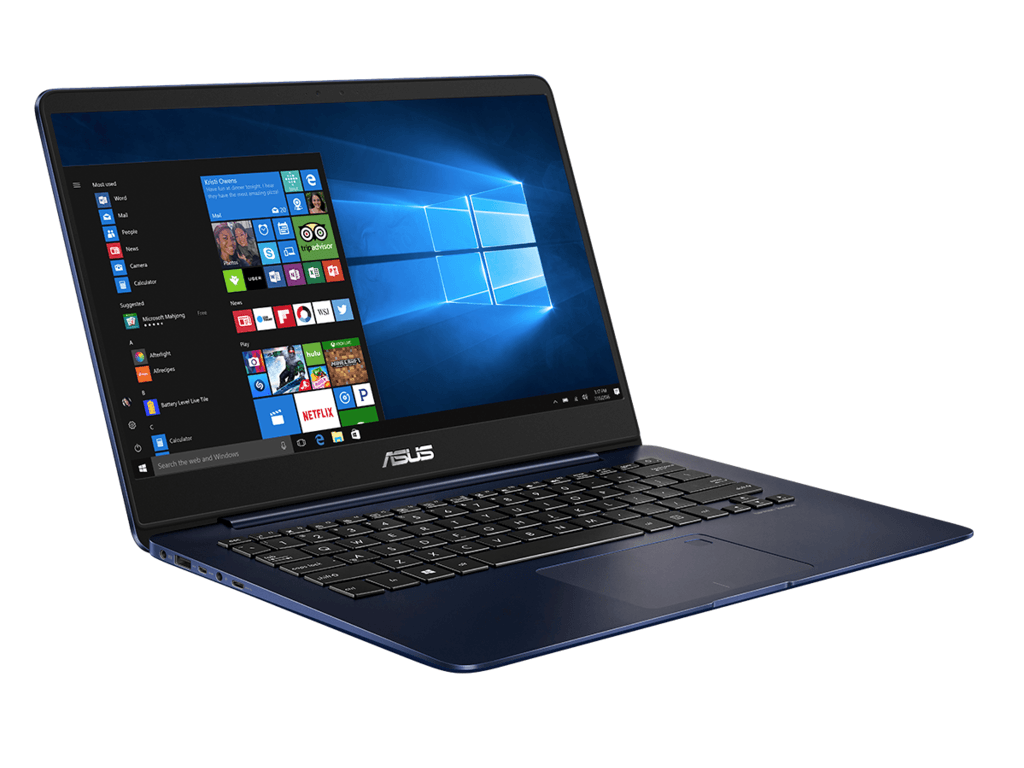
Asus ZenBook UX430UQ-PURE4
Ausstattung / Datenblatt
Preisvergleich
Durchschnitt von 4 Bewertungen (aus 7 Tests)
Testberichte für das Asus ZenBook UX430UQ-PURE4
Quelle: Tech2
 EN→DE Archive.org version
Asus has certainly delivered a stellar thin and light laptop with the UX430UQ with a display that is one of the best in its class. At Rs 93,990, you may be tempted to look elsewhere, but UX430UQ does make a compelling offering. Especially so if you are heavily invested in the Windows ecosystem. There are few Windows laptops — Dell XPS 13 being the most popular one — that bring together everything well in a single package — good display, excellent keyboard, long-lasting battery and good performance. The Asus UX430UQ is definitely one of them. If you are looking for a light laptop which can do more than just let you do office related work, the UX430UQ is one product that should definitely be under consideration.
Einzeltest, online verfügbar, Mittel, Datum: 06.11.2017
Bewertung: Gesamt: 80% Leistung: 75% Bildschirm: 85% Mobilität: 75% Gehäuse: 80% Ergonomie: 75%
Quelle: The Techy
EN→DE Archive.org versionThe Zenbook UX430UQ does not struggle to impress. I am impressed that ASUS came this close to perfection. Thanks to its all-aluminum design, this ultrabook is lightweight and compact – making it very useful for travel and presentations. I would recommend Asus ZenBook UX430UQ to anyone looking to buy a premium laptop without gaming as a priority. Don’t forget this ultrabook performs well, offers good battery life and packs a great keyboard and trackpad.
Einzeltest, online verfügbar, Sehr kurz, Datum: 31.10.2017
Quelle: Gadgets Now
EN→DE Archive.org versionThe Asus Zenbook UX430UQ comes in two variants -- the Core i5 version bears a price tag of Rs 70,990 and the i7 processor version bears a price tag of Rs 93,990. The laptop's biggest competitors are Apple's MacBook Pro and HP Spectre.
Einzeltest, online verfügbar, Mittel, Datum: 28.09.2017
Bewertung: Gesamt: 80%
Quelle: Toptenreviews
EN→DE Archive.org versionThe UX430UQ also gets a performance boost thanks to its dedicated GPU. The Nvidia GeForce 940MX isn’t exactly a top-shelf GPU, but it does add modest gaming capabilities to this unique ultrabook, comparatively supercharging it for any professionals that dabble in GPU-heavy tasks. While it’s true that to play any modern titles above 30fps, you will need to dial down the resolution to 720p and set graphics to Low, we haven’t seen anything like this in an ultrabook since Microsoft’s similarly specced Surface Book. It would have been nice to get a bigger and faster SSD (say, a 512GB PCIe model rather than the 256GB SATA 6Gbps), but when the more expensive competition don’t even really offer this, it’s hardly a fault.
Einzeltest, online verfügbar, Sehr kurz, Datum: 03.06.2017
Bewertung: Gesamt: 100%
Quelle: Laptopkalauz
 HU→DE Archive.org version
Positive: Comfortable keyboard; useful touchpad; fast fingerprint sensor; beautiful design; nice display; long battery life.
Einzeltest, online verfügbar, Mittel, Datum: 28.09.2017
Quelle: HwT
 DA→DE Archive.org version
Einzeltest, online verfügbar, Sehr Lang, Datum: 02.10.2017
Bewertung: Preis: 80% Leistung: 80% Gehäuse: 80%
Quelle: M3 PC för alla
 SV→DE Archive.org version
Einzeltest, online verfügbar, Kurz, Datum: 13.06.2017
Bewertung: Gesamt: 83%
Kommentar
NVIDIA GeForce 940MX: Notebook-Grafikkarte der Mittelklasse, die auf der Maxwell-Architektur basiert. Wird in 28 Nanometern gefertigt und verfügt über ein 64 Bit GDDR5/DDR3-Speicherinterface. Im Vergleich zur 940M kam die Unterstützung für GDDR5 hinzu.
Diese Klasse ist noch durchaus fähig neueste Spiele flüssig darzustellen, nur nicht mehr mit allen Details und in hohen Auflösungen. Besonders anspruchsvolle Spiele laufen nur in minimalen Detailstufen, wodurch die grafische Qualität oft deutlich leidet. Diese Klasse ist nur noch für Gelegenheitsspieler empfehlenswert. Der Stromverbrauch von modernen Grafikkarten in dieser Klasse ist dafür geringer und erlaubt auch bessere Akkulaufzeiten.
» Weitere Informationen gibt es in unserem Notebook-Grafikkartenvergleich und der Benchmarkliste.
i7-7500U: Auf der Kaby-Lake-Architektur basierender ULV-SoC (System-on-a-Chip) für schlanke Notebooks und Ultrabooks. Integriert unter anderem zwei CPU-Kerne mit 2,7 - 3,5 GHz Taktfrequenz sowie eine HD Graphics 620 Grafikeinheit und wird in 14-Nanometer-Technik gefertigt.» Weitere Infos gibt es in unserem Prozessorvergleich Vergleich mobiler Prozessoren und der Prozessoren Benchmarkliste .
 Als bevorzugte Quelle auf Google hinzufügen