

Notebookcheck Logo

Xiaomi Poco X8 Power Tests und Spezifikationen
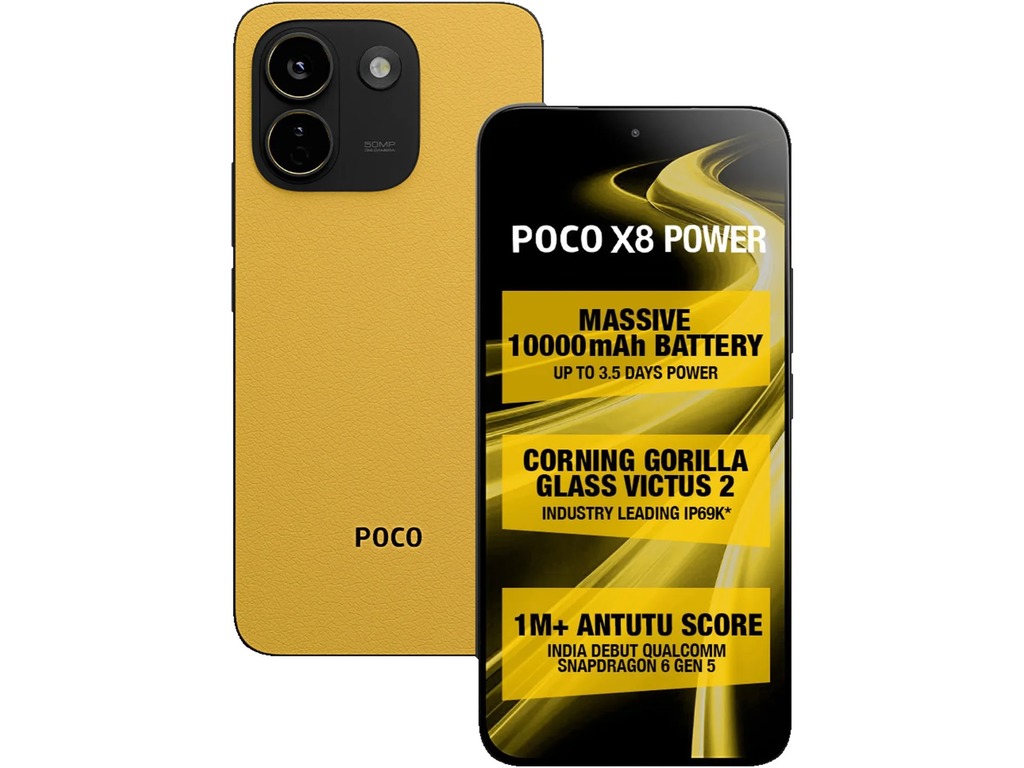
Xiaomi Poco X8 Power
Diese Seite liefert Infos aller Art, vor allem Testberichte, für das Modell Xiaomi Poco X8 Power der Serie Poco X8.

Ausstattung / Datenblatt

Xiaomi Poco X8 Power (Poco X8 Serie)
Prozessor
Qualcomm Snapdragon 6 Gen 5 8c/8t, 4 x 2.6 GHz ARM Cortex-A78, 4 x 2.0 GHz ARM Cortex-A55, Cortex-A78 / A55
RAM
8 GB 
Bildschirm
6.83 Zoll 19.5:9, 2772 x 1280 Pixel 447 PPI, Capacitive touchscreen, AMOLED, spiegelnd: ja, 120 Hz
Massenspeicher
256GB
Anschlüsse
USB-C Power Delivery (PD), 1 Infrared, 1 Fingerprint Reader, Sensoren: accelerometer, gyro, compass, proximity
Netzwerk
802.11 a/b/g/n/ac/ax (a/b/g/n = Wi-Fi 4/ac = Wi-Fi 5/ax = Wi-Fi 6/), Bluetooth 6.0, GSM, UMTS, LTE, 5G, Dual SIM, GPS
Abmessungen
Höhe x Breite x Tiefe (in mm): 8.6 x 163.4 x 78.3
Akku
10000 mAh Lithium-Ion
Betriebssystem
Android 16
Kamera
Primary Camera: 50 MPix (f/1.5, 26mm) + 8MP (f/2.2, 15mm)
Secondary Camera: 32 MPix (f/2.2)
Sonstiges
Tastatur: Virtual keyboard
Gewicht
229 g


Preisvergleich

Bewertung: 81.33% - Gut
Durchschnitt von 3 Bewertungen (aus 5 Tests)
Preis: - %, Leistung: 83%, Ausstattung: - %, Bildschirm: 84% Mobilität: 93%, Gehäuse: 89%, Ergonomie: - %, Emissionen: - %

Testberichte für das Xiaomi Poco X8 Power

82% POCO X8 Power Review: 10000mAh Battery, Budget Phone Killer?
Quelle: Exhibit.tech Englisch EN→DE
I went in expecting the 10,000mAh battery to be the only thing worth writing about. It wasn't. Two to three days of real-world use on a single charge is the number that still surprised me the most, but the X8 Power also gave me a Snapdragon 6 Gen 5 chipset that ran BGMI at max settings without breaking a sweat, a 120Hz AMOLED display backed by stereo speakers that were perfect for streaming video and games, and a leather-back build with durability ratings that make the extra weight a fair trade. It's not without rough edges.
Einzeltest, online verfügbar, Kurz, Datum: 23.09.2026
Bewertung: Gesamt: 82% Leistung: 85% Bildschirm: 80% Mobilität: 100% Gehäuse: 90%
4 reasons to buy the POCO X8 Power and 3 reasons not to
Quelle: 91mobiles Englisch EN→DE
The POCO X8 Power is a phone that does a lot of things well while putting battery life front and centre. The 10,000mAh battery is easily its biggest selling point, but you also get a very good AMOLED display, reliable everyday performance, and a durable build. POCO hasn’t sacrificed the rest of the phone’s aspects just to fit in a bigger battery.
Einzeltest, online verfügbar, Sehr kurz, Datum: 22.09.2026
82% POCO X8 Power review: more than just a 10,000mAh battery
Quelle: 91mobiles Englisch EN→DE
The POCO X8 Power retails at Rs 35,999 for the 8GB + 128GB and Rs 38,999 for the 8GB + 256GB variant. For its price, this is a phone that puts battery life front and centre, and it delivers exactly where it matters. The 10,000mAh cell comfortably gets me through two days of use, while the 100W charging means you don’t have to wait too long when it finally needs a top-up.
Einzeltest, online verfügbar, Lang, Datum: 16.09.2026
Bewertung: Gesamt: 82% Leistung: 80% Bildschirm: 87% Mobilität: 85% Gehäuse: 87%
80% Poco X8 Power review: Good looks and monster battery in one package
Quelle: India Today Englisch EN→DE
So now that we have discussed everything about the Poco X8 Power, where does the device stand in the ever-changing smartphone market? The X8 Power gets a lot of things right. The battery life is the highlight and the display feels immersive. The device does have some quirks.
Einzeltest, online verfügbar, Kurz, Datum: 07.09.2026
Bewertung: Gesamt: 80%
Đánh giá POCO X8 Power: Pin 10.000 mAh, màn hình AMOLED 3.500 nit, chip Snapdragon 6 Gen 5
Quelle: FPT shop VN→DE
Einzeltest, online verfügbar, Kurz, Datum: 18.09.2026

Kommentar

Qualcomm Adreno 812: Grafikchip für Smartphones und Tablets, integriert im Qualcomm Snapdragon 6 Gen 5 SoC. Laut Qualcomm um 40% schneller als die alte Vorgängergeneration (Adreno 710). Laut Qualcomm ist die GPU bis zu 20% schneller als der Vorgänger Adreno 810. 

Einige nicht anspruchsvolle aktuelle Spiele können mit geringen Details noch flüssig gespielt werden. Für Office und Video natürlich ausreichende Leistungsreserven.

» Weitere Informationen gibt es in unserem Notebook-Grafikkartenvergleich und der Benchmarkliste.


SD 6 Gen 5: Der Qualcomm Snapdragon 6 Gen 5 (SM6850) ist ein auf ARMv8 basiertes SoC. Die CPU-Einheit besteht aus zwei Clustern: Diese setzen sich aus vier  Leistungskernen (Cortex A78, bis zu 2,6 GHz) sowie vier Stromspareinheiten (Cortex A55, bis zu 2,0 GHz) zusammen. Als Arbeitsspeicher kann entweder LPDDR4x (bis zu 2.133 MHz) oder LPDDR5 (bis zu 3.200 MHz) zum Einsatz kommen. Die Grafikberechnungen übernimmt die integrierte Adreno 812.» Weitere Infos gibt es in unserem Prozessorvergleich Vergleich mobiler Prozessoren und der Prozessoren Benchmarkliste .


Ähnliche Geräte mit den selben Spezifikationen

Geräte anderer Hersteller

Geräte mit der selben Bildschirmgröße und/oder ähnlichem Gewicht

Xiaomi Poco M8x: Tests und Spezifikationen
Adreno 629, Snapdragon 4 SD 4 Gen 5, 6.90", 0.232 kg
Xiaomi Poco F9 Pro – Tests und Spezifikationen
Adreno 840 V Series, Snapdragon 8 SD 8 Elite Gen 5 V Series, 6.59", 0.206 kg
Xiaomi Poco F9 Ultra – Tests und Spezifikationen
Adreno 840, Snapdragon 8 SD 8 Elite Gen 5, 6.90", 0.235 kg
Xiaomi Redmi 17 4G – Tests und Spezifikationen
Mali-G52 MP2, unknown, 6.90", 0.232 kg
Xiaomi Poco M8 Power – Tests und Spezifikationen
Adreno 613, Snapdragon 4 SD 4 Gen 4, 6.99", 0.225 kg
Xiaomi Redmi K100 Pro Max: Tests und Spezifikationen
Adreno 840, Snapdragon 8 SD 8 Elite Gen 5, 6.90", 0.238 kg
Xiaomi Redmi K100 Pro Tests und Spezifikationen
Adreno 840, Snapdragon 8 SD 8 Elite Gen 5, 6.59", 0.218 kg
Xiaomi Redmi 17 5G – Tests und Spezifikationen
Adreno 629, Snapdragon 4 SD 4 Gen 5, 6.90", 0.232 kg
Xiaomi Poco M8s Tests und Spezifikationen
Adreno 619, Snapdragon 6 SD 6s Gen 3, 6.90", 0.217 kg
Xiaomi Redmi A7 Tests und Spezifikationen
Mali-G57 MP1, T7250 (T615), 6.88", 0.193 kg
Xiaomi Redmi 17C: Tests und Spezifikationen
Mali-G52 MP2, Mediatek Helio G Helio G81 Ultra, 6.88", 0.206 kg
Xiaomi Redmi K90 Ultra – Tests und Spezifikationen
Adreno 830, Snapdragon 8 SD 8 Elite, 6.83", 0.227 kg
Xiaomi Redmi Turbo 5 Max Tests und Spezifikationen
Immortalis-G925 MC11, Dimensity 9000 Dimensity 9500s, 6.83", 0.219 kg
Xiaomi Redmi A3x Tests und Spezifikationen
GE8322 / IMG8322, unknown, 6.71", 0.193 kg
Xiaomi Redmi Note 17 Pro 5G – Tests und Spezifikationen
Adreno 710, Snapdragon 6 SD 6s Gen 4, 6.83", 0.223 kg
Xiaomi Redmi Note 17 5G: Tests und Spezifikationen
Adreno 613, Snapdragon 4 SD 4 Gen 4, 6.99", 0.225 kg
Xiaomi Redmi Note 17 – Tests und Spezifikationen
Adreno 610, Snapdragon SD 6s 4G Gen 2, 6.99", 0.224 kg
Xiaomi 18 Fold: Tests und Spezifikationen
ARM Mali G2-Ultra NX MP16, Xring Xiaomi Xring O3, 7.58", 0.219 kg
Xiaomi Redmi A7 Pro
Mali-G57 MP1, T7250 (T615), 6.90", 0.208 kg
Xiaomi Redmi K90 Max
Mali-G1 Ultra MC12, Dimensity 9000 Dimensity 9500, 6.83", 0.227 kg
Xiaomi Poco C85x
Mali-G57 MP2, T8300, 6.90", 0.21 kg

Laptops des selben Herstellers

Xiaomi RedmiBook Pro 14 2026
Arc B390 Panther Lake iGPU, Panther Lake Ultra X7 358H, 14.00", 1.48 kg
Xiaomi Redmi Pad 2 9.7
Adreno 610, Snapdragon SD 6s 4G Gen 2, 9.70", 0.406 kg
Google LogoAls bevorzugte Quelle auf Google hinzufügen
Mail Logo
> Notebook Test, Laptop Test und News > Externe Tests > Xiaomi Poco X8 Power Tests und Spezifikationen
Autor: DeepL / Ninh Duy (Update: 30.09.2026)