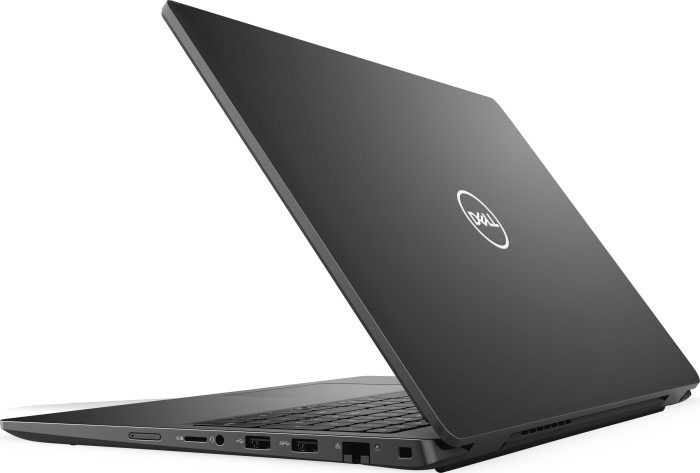




Dell Latitude 15 3520-7D36T
Ausstattung / Datenblatt
Preisvergleich
Testberichte für das Dell Latitude 15 3520-7D36T
Quelle: Laptop Media
 Archive.org version
Einzeltest, online verfügbar, Kurz, Datum: 08.03.2022
Quelle: Laptop Media
EN→DE Archive.org versionSo who is this laptop aimed at? Is it the business person that needs a secure laptop, or is it for companies, that are going to buy it in bulk? Well, we feel like it is the latter. And this is because of one thing in particular. While its simplistic design is visually appealing, the build quality is just not there. The base cracks and squeaks every time you twist it, which is definitely not a sign of attention to detail and structural rigidity. Dell Latitude 15 3520’s IPS panel has a Full HD resolution, comfortable viewing angles, and a good contrast ratio. Unfortunately, it covers only 53% of the sRGB color gamut, and it uses relatively low-frequency PWM up to 89 nits. Thankfully, the more sensitive users can take advantage of our Health-Guard profile, which completely eliminates the issue. Apart from that, there are some pretty sweet features like the wide I/O, which may not include a Thunderbolt 4 connection, but offers a USB Type-C 3.2 (Gen. 2×2). This provides a 20Gbps speed, which is twice as fast as the USB Type-C 3.2 (Gen. 2) port.
Einzeltest, online verfügbar, Lang, Datum: 28.10.2021
Quelle: Laptop Media
Archive.org versionSupport, online verfügbar, Sehr kurz, Datum: 28.10.2021
Kommentar
Intel Iris Xe G7 80EUs: Integrierte Grafikkarte (in Tiger-Lake G4 SoCs) der Gen. 12 Architektur mit 80 EUs. Z.B. in Tiger Lake i5 CPUs verbaute iGPU.
Diese Klasse ist noch durchaus fähig neueste Spiele flüssig darzustellen, nur nicht mehr mit allen Details und in hohen Auflösungen. Besonders anspruchsvolle Spiele laufen nur in minimalen Detailstufen, wodurch die grafische Qualität oft deutlich leidet. Diese Klasse ist nur noch für Gelegenheitsspieler empfehlenswert. Der Stromverbrauch von modernen Grafikkarten in dieser Klasse ist dafür geringer und erlaubt auch bessere Akkulaufzeiten.
» Weitere Informationen gibt es in unserem Notebook-Grafikkartenvergleich und der Benchmarkliste.
i5-1135G7: Auf der Tiger-Lake-Architektur basierender ULV-SoC (System-on-a-Chip) für schlanke Notebooks und Ultrabooks. Integriert unter anderem vier CPU-Kerne mit 2,4 - 4,2 GHz und HyperThreading sowie eine starke G7 Grafikeinheit mit 80 Eus und wird in 10-Nanometer-Technik gefertigt (10nm+). » Weitere Infos gibt es in unserem Prozessorvergleich Vergleich mobiler Prozessoren und der Prozessoren Benchmarkliste .
 Als bevorzugte Quelle auf Google hinzufügen