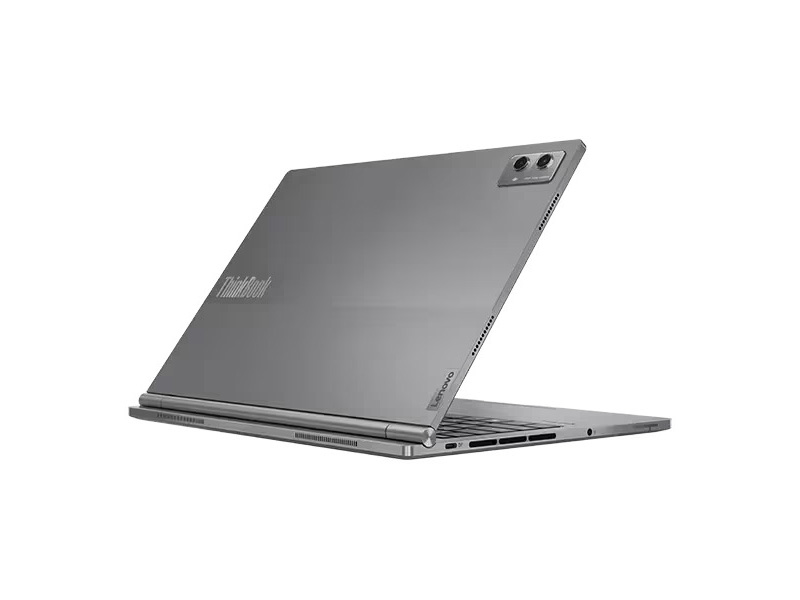




Lenovo ThinkBook Plus Gen5 Hybrid
Ausstattung / Datenblatt

Primary Camera: 13 MPix + 5MP
Preisvergleich
Durchschnitt von 8 Bewertungen (aus 11 Tests)
Testberichte für das Lenovo ThinkBook Plus Gen5 Hybrid
Der hybride Windows-Android-Ansatz kann effektiv sowohl Ihren Laptop als auch Ihr Tablet ersetzen. Allerdings bietet das 2-in-1-Gerät von Lenovo weder bei Akkulaufzeit noch beim Gewicht wesentliche Vorteile gegenüber der Nutzung eines separaten Notebooks und Tablets.
Quelle: Android Central
 EN→DE
EN→DEOn one hand, the ThinkBook Plus Gen 5 Hybrid is something that I want to recommend to anyone and everyone. On the other, I think that between the price and how cumbersome it can be to detach the screen, it needs a bit more time in the oven. However, I'm really (and I mean REALLY) hoping that Lenovo doesn't give up on this idea. Lenovo has a tendency to try out different things, releasing one iteration and then moving on to something else. I'd like to see Lenovo continue attempting to refine the design to make it both less heavy and somehow easier to detach the screen.
Einzeltest, online verfügbar, Kurz, Datum: 18.03.2025
Bewertung: Gesamt: 70%
Quelle: Techradar
EN→DEThe Lenovo ThinkBook Plus Gen 5 Hybrid is technically a powerful Android tablet and competent Ultrabook in one. It’s a unique form factor that redefines the meaning of two-in-one, plus it allows for access to two different OS’ (which you can share between) and an accurate and sensitive stylus. This unique form factor will only intrigue a small group of people, not to mention that it’s prohibitively expensive when not discounted.
Einzeltest, online verfügbar, Lang, Datum: 12.02.2025
Bewertung: Gesamt: 80% Preis: 80% Leistung: 90% Mobilität: 80% Gehäuse: 80%
Quelle: PC Mag
EN→DEWith the ThinkBook Plus Gen 5, Lenovo cleverly merged a Windows laptop with an Android tablet into a single device. It’s an excellent choice for those who need to multitask across operating systems or appreciate the convenience of having two devices in one, particularly for traveling. The physical integration is well done; most people wouldn’t realize the screen is an Android tablet. The tablet itself is commendable for its performance in use and stunning OLED display. Lenovo also includes a stylus for inking and an easel stand for the tablet. However, this clever combination isn’t flawless: It is heavier and thicker than a typical 14-inch laptop, and you'll find minimal software integration between Windows and Android. Plus, the whole device is more expensive than buying a Windows laptop and an Android tablet separately. These drawbacks are enough to keep the ThinkBook Plus Gen 5 from higher honors, but if you value the unique 2-in-1 experience the device provides, you surely won't find that anywhere else.
Einzeltest, online verfügbar, Mittel, Datum: 17.12.2024
Bewertung: Gesamt: 70%
Quelle: Techaeris
EN→DEThe Lenovo ThinkBook Plus Gen 5 Hybrid is a very cool concept, but I think this is for a very niche audience. For most people, buying a decent $1,000 laptop and a $500 tablet is still going to be a better option. That doesn’t mean this device isn’t cool and useful, it’s just not for everyone. Because the audience is so narrow and the price is high, I just wouldn’t recommend this for everyone. But if this is what you’re looking for, then this is one, if not the only, choice for you.
Einzeltest, online verfügbar, Lang, Datum: 09.11.2024
Bewertung: Gesamt: 90% Preis: 85% Leistung: 95% Bildschirm: 95% Mobilität: 90% Gehäuse: 95%
Quelle: Android Police
EN→DEHere comes the real crux of the matter. Does it make sense to buy a premium tablet and laptop built into one cohesive unit? For some users, this may be a resounding yes. The convenience of carrying around a laptop that can quickly transform into multiple devices is hard to ignore. Both devices are well-built, performance champions that will provide a great experience. My struggle with this device ultimately keeps coming back to a broader question: is a device like this needed in today’s market? I suspect it’s not necessary for most.
Einzeltest, online verfügbar, Mittel, Datum: 19.10.2024
Bewertung: Gesamt: 70%
Quelle: Zdnet.com
EN→DEThe Lenovo ThinkBookPlus Gen 5 Hybrid starts at $3,518. Due to its high price tag and unorthodox dual system, I can't recommend this to most people. The fifth-generation ThinkBook Plus Gen 5 just doesn't offer an engaging laptop experience beyond its, admittedly fun, gimmick. Not only is it expensive, but its design makes it difficult to use. This model has only four ports: three USB-C and one for headphones. There's nothing for USB-A or HDMI. For most users, I recommend getting something that specializes in either Windows 11 or Android, such as the Lenovo Slim 7.
Einzeltest, online verfügbar, Kurz, Datum: 03.10.2024
Quelle: Zdnet.com
EN→DEThe Lenovo ThinkBookPlus Gen 5 Hybrid starts at $3,518. Due to its high price tag and unorthodox dual system, I can't recommend this to most people. The fifth-generation ThinkBook Plus Gen 5 just doesn't offer an engaging laptop experience beyond its, admittedly fun, gimmick. Not only is it expensive, but its design makes it difficult to use. This model has only four ports: three USB-C and one for headphones. There's nothing for USB-A or HDMI. For most users, I recommend getting something that specializes in either Windows 11 or Android, such as the Lenovo Slim 7.
Einzeltest, online verfügbar, Kurz, Datum: 03.10.2024
Quelle: PC World
EN→DEThe Lenovo ThinkBook Plus Gen 5 Hybrid is a very cool machine. I’m glad Lenovo is creating interesting and unique experiences like this one and bringing them to market. (I was also impressed by the dual-screen Lenovo Yoga Book 9i laptop, which I reviewed earlier this year). The elephant in the room is the price. $3,518 is a lot of money for a laptop. For that much money, you could get both a capable Windows laptop and a high-quality Android tablet. You could use both devices at once. In fact, you’d probably spend less than $3,518 on that dual-device setup – even if you splurged. Many people looking at a machine like this one may prefer a 2-in-1 that runs Windows in both modes, like Microsoft’s Surface Pro.
Einzeltest, online verfügbar, Lang, Datum: 25.09.2024
Bewertung: Gesamt: 76%
Quelle: Digital Trends
EN→DEWhen I signed up to review the ThinkBook Plus Gen 5 Hybrid, I was looking forward to seeing how well a hybrid device could meet two very different needs. Let’s face it — what you want in a laptop isn’t exactly what you want in a tablet. And I can comfortably say that the two modes work well enough, separately and together, that you’re not compromising the experience to gain the integration. But outside of some challenges that are likely software-related, namely getting the machine to start up when switching modes, there’s one primary flaw that software can’t address. Namely, it’s how the tablet connects to the laptop base. It’s too finicky, and I often felt like I was forcing something that might break.
Einzeltest, online verfügbar, Mittel, Datum: 22.09.2024
Bewertung: Gesamt: 60%
Quelle: Lon.TV
Einzeltest, online verfügbar, Sehr Lang, Datum: 19.09.2024
Quelle: Zdnet.com
EN→DEThe IdeaPad 5x's biggest difference is its 14-inch WUXGA (1920 x 1200 pixels) OLED touchscreen. Its display covers the entire DCI-P3 color gamut, delivering "crisp visuals" when used in laptop or tablet configurations. It's also "highly portable," clocking in at 3.3 pounds and measuring 17.5m (roughly 0.69 inches) thick. The Lenovo IdeaPad 5x 2-in-1 will be released later this month. Prices are also unknown for this model, but online sources state it'll cost $849, making it similarly affordable for a Copilot+ laptop as the ThinkBook.
Einzeltest, online verfügbar, Mittel, Datum: 14.09.2024
Kommentar
Modell:
Das Lenovo ThinkBook Plus Gen 5 Hybrid führt ein einzigartiges Konzept ein, indem es ein Windows 11-Notebook mit einem Android-Tablet in einem Gerät kombiniert und nahtloses Multitasking zwischen beiden Betriebssystemen ermöglicht. Diese hybride Konfiguration bietet den Komfort, nur ein Gerät mit sich zu führen, anstatt sowohl einen Laptop als auch ein Tablet zu besitzen, obwohl sie einige Kompromisse mit sich bringt, darunter eine unvollkommene Software-Integration und ein erhebliches Gewicht. Auf den ersten Blick mag dieses Gerät wie ein typisches 14-Zoll-2-in-1-Notebook aussehen, mit seinem Luna Grey-Gehäuse, das professionell und langlebig ist, und seiner Aluminiumkonstruktion, die sich nicht verbiegen lässt. Das hybride Design ermöglicht es jedoch, den Bildschirm abzunehmen und als Android-Tablet zu verwenden, was eine Flexibilität bietet, die bei herkömmlichen Geräten nicht gegeben ist. Das Tablet funktioniert unabhängig, wenn es abgenommen wird, und verfügt über einen Ständer und einen digitalen Stift für die Tintenmarkierung. Trotz seiner Vielseitigkeit ist dieses Modell sperrig und wiegt insgesamt 3,87 Pfund, was deutlich schwerer ist als die meisten ultraportablen Laptops. Während die Abmessungen (12,3 x 8,8 Zoll) dem Standard für ein 14-Zoll-Notebook entsprechen, ist es mit einer Dicke von 0,63 Zoll deutlich dicker als üblich. Das ThinkBook wird von einem Intel Core Ultra 7 155H-Prozessor (16 Kerne, 4,8 GHz Turbo) mit integrierter Intel Arc-Grafik, 32 GB Arbeitsspeicher und einer 1 TB großen SSD angetrieben und ist damit für anspruchsvolle Aufgaben bestens geeignet. Auf dem Tablet läuft Android 13 mit einer Qualcomm Snapdragon 8+ Gen 1 CPU, 12 GB RAM und 256 GB Speicher. Obwohl es nicht mit Gaming-PCs konkurrieren kann, kann das ThinkBook die meisten Produktivitätsaufgaben effizient erledigen.
Das Notebook verfügt über ein 14-Zoll-OLED-Display mit einer Auflösung von 2.880 x 1.800 Pixeln (Seitenverhältnis 16:10), das leuchtende Farben, eine hohe Helligkeit (411 nits) und eine hervorragende Farbabdeckung bietet. Der Bildschirm ist berührungsempfindlich, und ein Stift zum Schreiben ist im Lieferumfang enthalten. Für die Verwendung als Tablet könnte sich die Auflösung jedoch etwas schmal anfühlen, hier wäre ein Seitenverhältnis von 3:2 vorzuziehen. Die Tests zur Akkulaufzeit zeigen, dass das ThinkBook gut abschneidet, obwohl die genauen Ergebnisse von der Nutzung abhängen. Bei der Videowiedergabe zeigt es eine solide Leistung, wobei das OLED-Display zu einem geringeren Stromverbrauch beiträgt. Das Aufladen erfolgt bequem über zwei Thunderbolt-4-Anschlüsse, die auch das gleichzeitige Aufladen von Basisstation und Tablet unterstützen. Das ThinkBook verfügt über eine begrenzte Anzahl an Anschlüssen: zwei Thunderbolt-4-Anschlüsse (USB Typ-C), eine 3,5-mm-Audiobuchse und einen USB Typ-C-Anschluss am Tablet zum unabhängigen Laden. Beide Geräte unterstützen Wi-Fi 6E und Bluetooth 5.3. Die Tastatur und das Touchpad des Geräts sind erstklassig und bieten reaktionsschnelles Tippen und große Touchpad-Flächen. Die 1080p-Webcam liefert eine durchschnittliche Leistung, während die rückwärtigen Kameras des Tablets (13MP und 5MP) anständig, aber unpraktisch für Tablet-Fotografie sind. Das Lenovo ThinkBook Plus Gen 5 Hybrid ist ein innovatives, aber schweres Gerät, das die Funktionen eines Laptops und eines Tablets in sich vereint. Während es in Sachen Displayqualität, Leistung und Vielseitigkeit glänzt, könnten das Gewicht, die begrenzte Software-Integration und der Preis einige Nutzer abschrecken. Es ist eine leistungsstarke Option für diejenigen, die nach einem Hybridgerät suchen, aber es kann die Erfahrung der Verwendung separater Laptop- und Tablet-Konfigurationen nicht vollständig ersetzen.
Praxisnaher Artikel von Jagadisa Rajarathnam
Intel Arc 8-Core: Integrierte Grafikkarte basierend auf die Xe LPG Architektur (ähnlich zu den dedizierten Arc GPUs, jedoch mit Fokus auf Effizienz). Bietet alle 8 Xe Kerne (128 Xe Vector Engines) und 8 Raytracing Einheiten.
Diese Klasse ist noch durchaus fähig neueste Spiele flüssig darzustellen, nur nicht mehr mit allen Details und in hohen Auflösungen. Besonders anspruchsvolle Spiele laufen nur in minimalen Detailstufen, wodurch die grafische Qualität oft deutlich leidet. Diese Klasse ist nur noch für Gelegenheitsspieler empfehlenswert. Der Stromverbrauch von modernen Grafikkarten in dieser Klasse ist dafür geringer und erlaubt auch bessere Akkulaufzeiten.
» Weitere Informationen gibt es in unserem Notebook-Grafikkartenvergleich und der Benchmarkliste.
Ultra 7 155H: Auf der Meteor-Lake-Architektur basierender High-End Mobilprozessor. Bietet 6 Performance-Kerne mit bis zu 4,8 GHz und 8+2 Effizienzkerne mit bis zu 3,8 GHz und kann 22 Threads gleichzeitig bearbeiten.» Weitere Infos gibt es in unserem Prozessorvergleich Vergleich mobiler Prozessoren und der Prozessoren Benchmarkliste .
 Als bevorzugte Quelle auf Google hinzufügen