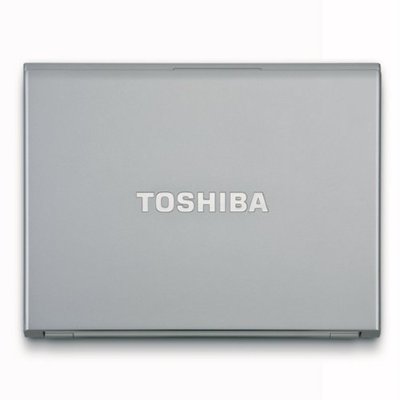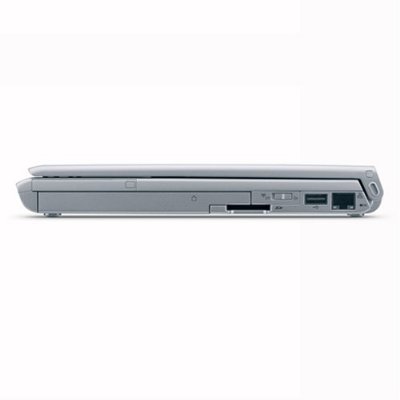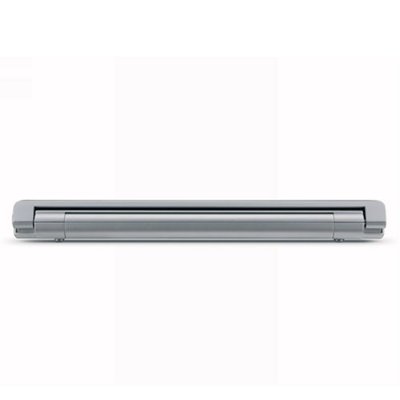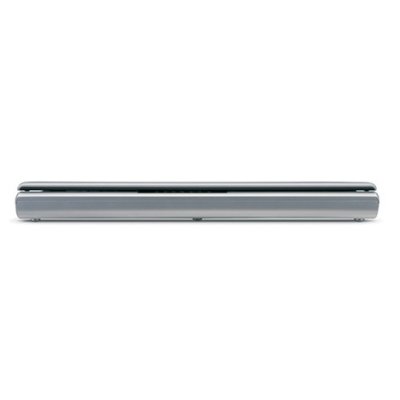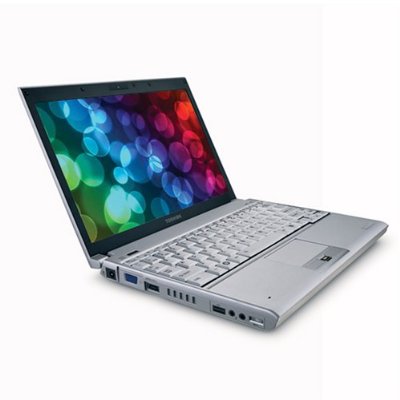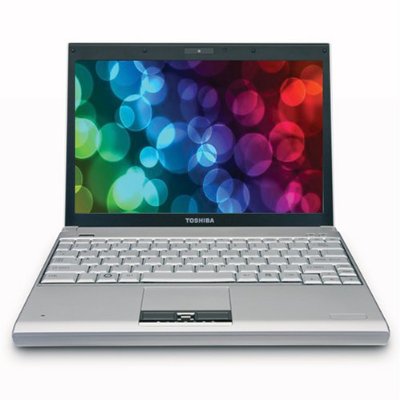




Toshiba Portege A605
Ausstattung / Datenblatt
Preisvergleich
Durchschnitt von 1 Bewertungen (aus 2 Tests)
Testberichte für das Toshiba Portege A605
Quelle: Maximum PC
 EN→DE Archive.org version
Neither the R600 nor the A605 are the best-performing ultraportables we’ve tested. That honor goes to HP’s 2530p and Lenovo’s X200s (both also reviewed in August), which featured 1.86GHz Core 2 Duo procs. The R600 overcame this deficit with its near-weightlessness. The less-expensive A605 doesn’t have this special quality. It does, however, have respectable performance, a strong feature set, and a damn good price.
Einzeltest, online verfügbar, Mittel, Datum: 16.10.2009
Bewertung: Gesamt: 80%
Quelle: Notebookreview.com
EN→DE Archive.org versionThe Toshiba Portege A605 offers good looks and a small form factor, but compromises build quality to achieve its very low weight. The palm rest, keyboard, and screen all exhibit a good amount of flex, which doesn’t bode well for thoughts of durability. Looking past the flexible chassis, the notebook does offer a built-in optical drive, and still keeps the overall weight to just above 3lbs. For a business traveler who only cares about that, this notebook falls right in the weight range of most netbooks. With the current list price of $1,399 it is priced against the Lenovo ThinkPad X200 or about double the price of an HP Pavilion dv2. Overall I think the Portege A605 offers a lot potential for a customer interested in a good looking business notebook, but it has a few areas that could see some improvement.
Einzeltest, online verfügbar, Lang, Datum: 11.05.2009
Bewertung: Mobilität: 80% Emissionen: 80%
Kommentar
Intel Graphics Media Accelerator (GMA) 4500MHD: Im GM45, GS45 und GE45 Chipsatz (Montevina Plattform) integrierte shared Memory Grafikkarte von Intel. Durch höhere Taktung und mehr Shader ist sie deutlich schneller als die X3100, jedoch immer noch nicht für Spieler empfehlenswert. Kann HD-Videos (AVC/VC2/MPEG2) dekodieren und so die CPU entlasten.
Diese Karten können nur sehr alte und sehr anspruchslose 3D Spiele flüssig darstellen. Anwendungen wie Office, Internet surfen, Bildbearbeitung oder (SD) Videoschnitt sind jedoch ohne große Einschränkungen möglich.
» Weitere Informationen gibt es in unserem Notebook-Grafikkartenvergleich und der Benchmarkliste.
Intel Core 2 Duo: Core Duo Nachfolger mit längerer Pipeline und 5-20% Geschwindigkeitszuwachs bei 0.5 - 3 Watt mehr Stromverbrauch.
Der Notebook Core 2 Duo ist baugleich mit den Desktop Core 2 Duo Prozessoren, jedoch werden die Notebook-Prozessoren mit niedrigeren Spannungen und geringerem Frontsidebus Takt betrieben. Von der Leistung bleiben gleichgetaktete Notebooks deswegen (und auch wegen der langsameren Festplatten) 20-25% hinter Desktop PCs.
SU9400:
Stromsparender Low Voltage Prozessor basierend auf den Penryn-3M Kern.
» Weitere Infos gibt es in unserem Prozessorvergleich Vergleich mobiler Prozessoren und der Prozessoren Benchmarkliste .
 Als bevorzugte Quelle auf Google hinzufügen