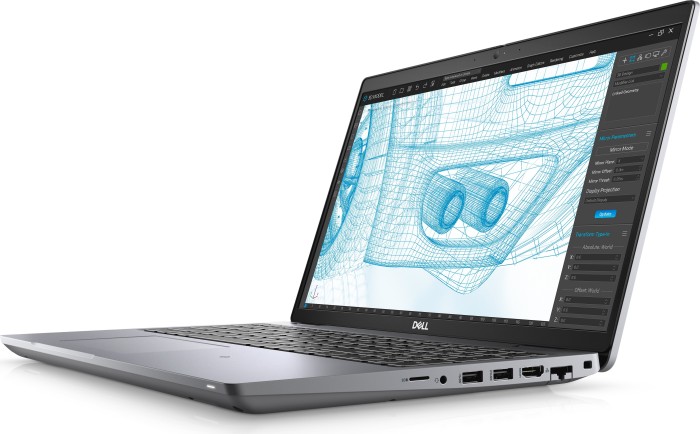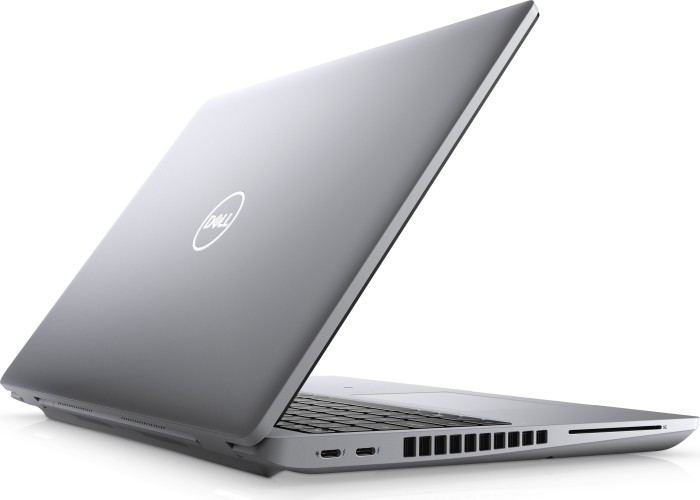




Dell Precision 15 3561-YWR00
Ausstattung / Datenblatt
Preisvergleich
Testberichte für das Dell Precision 15 3561-YWR00
Quelle: Laptop Media
 EN→DE Archive.org version
One thing we want to mention before we put everything into perspective is that there are better devices for 3D manipulation, especially if you can make use of the CUDA cores. Indeed, having a professional-grade graphics card is great, but this one is on the level of a GTX 1650, so it is clearly one of the lowest spec proper GPUs out there. Perhaps people using workstations will agree – having slots for RAM and storage is pretty important in the industry. Well, yes, you don’t get ECC memory support, but the general idea of having a high amount of memory and storage is refreshing. By the way, let’s not forget the optional IR face recognition, fingerprint reader, and LTE connectivity you can get. We are waiting to get the HP ZBook Power G8, and Lenovo ThinkPad P15v Gen 2 in our office, so stay tuned for direct comparisons between them in the near future.
Einzeltest, online verfügbar, Sehr Lang, Datum: 06.10.2021
Quelle: Laptop Media
Archive.org versionSupport, online verfügbar, Sehr kurz, Datum: 06.10.2021
Kommentar
NVIDIA T600 Laptop GPU: Professionelle Mid-Range Notebook-Grafikkarte der Turing Generation. Mit 896 Shadern vergleichbar mit der GTX 1650 Consumer Grafikkarte. Bietet keine Raytracing und Tensor-Kerne im Gegensatz zu den stärkeren RTX Modellen.
Diese Klasse ist noch durchaus fähig neueste Spiele flüssig darzustellen, nur nicht mehr mit allen Details und in hohen Auflösungen. Besonders anspruchsvolle Spiele laufen nur in minimalen Detailstufen, wodurch die grafische Qualität oft deutlich leidet. Diese Klasse ist nur noch für Gelegenheitsspieler empfehlenswert. Der Stromverbrauch von modernen Grafikkarten in dieser Klasse ist dafür geringer und erlaubt auch bessere Akkulaufzeiten.
» Weitere Informationen gibt es in unserem Notebook-Grafikkartenvergleich und der Benchmarkliste.
i9-11950H: Auf der Tiger-Lake-Architektur basierender SoC (System-on-a-Chip) für große Gaming Notebooks und mobile Workstations. Integriert unter anderem acht CPU-Kerne mit 2,6 - 5 GHz und HyperThreading sowie eine UHD Graphics Grafikeinheit (350 - 1450 MHz) und wird in 10-Nanometer-Technik gefertigt (10nm SuperFin). Unterstützt vPro aber keine Übertaktungsmöglichkeiten im Vergleich zum i9-11980HK.» Weitere Infos gibt es in unserem Prozessorvergleich Vergleich mobiler Prozessoren und der Prozessoren Benchmarkliste .
 Als bevorzugte Quelle auf Google hinzufügen