



Lenovo V15 IML-82NB002RUS
Ausstattung / Datenblatt
Preisvergleich
Testberichte für das Lenovo V15 IML-82NB002RUS
Quelle: Laptop Media
 Archive.org version
Support, online verfügbar, Sehr kurz, Datum: 23.11.2021
Quelle: Laptop Media
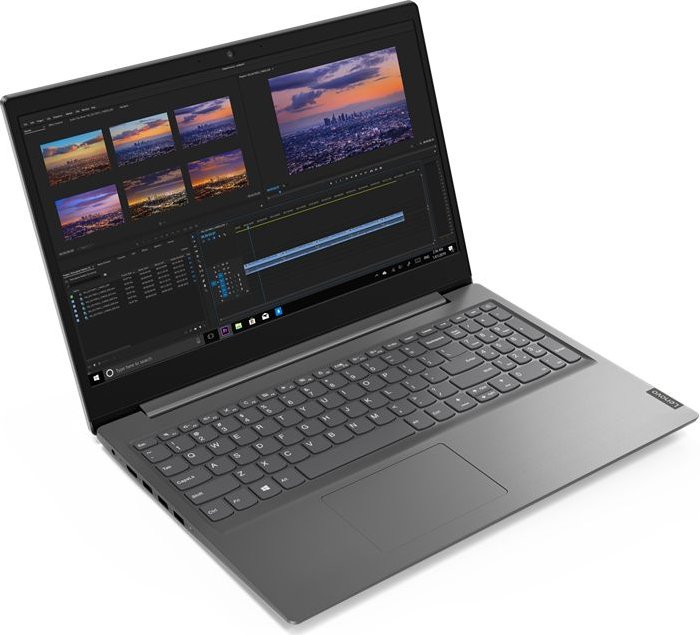
EN→DE Archive.org versionThe affordable business laptop industry is a niche where you can win a lot, or lose massively. There are millions of people around the world that are potential customers, which makes the brands want to be more appealing. Well, the V15 (G1 IML) has some features that are pretty convincing. For example, the keyboard is super comfortable and offers spill resistance. The touchpad offers accurate tracking, and nimble response, which adds up to one of the best input device packages in this class at the moment. Interestingly, the small 35Wh battery doesn’t seem to bottleneck the experience as much as we expected. We were able to get more than 7 hours and a half of Web browsing, or nearly 7 hours of video playback. Lenovo V15 (G1 IML)’s TN panel has a Full HD resolution, fast pixel response times, and doesn’t use PWM for brightness adjustment. Unfortunately, the narrow viewing angles and the low contrast ratio make for a rather unpleasant experience. Also, it only covers 54% of the sRGB color gamut. Then comes the upgradeability, which is a bit of a mixed bag.
Einzeltest, online verfügbar, Sehr Lang, Datum: 23.11.2021
Kommentar
Intel UHD Graphics 620: Integrierte Grafikkarte (GT2-Ausbau, 24 EUs), welche in einigen Kaby-Lake-CPUs (Refresh, ULV-Modelle, 15 Watt TDP) verbaut wird. Technisch identisch zur HD Graphics 620 in den Kaby-Lake Modellen aus 2016.
Diese Klasse ist noch durchaus fähig neueste Spiele flüssig darzustellen, nur nicht mehr mit allen Details und in hohen Auflösungen. Besonders anspruchsvolle Spiele laufen nur in minimalen Detailstufen, wodurch die grafische Qualität oft deutlich leidet. Diese Klasse ist nur noch für Gelegenheitsspieler empfehlenswert. Der Stromverbrauch von modernen Grafikkarten in dieser Klasse ist dafür geringer und erlaubt auch bessere Akkulaufzeiten.
» Weitere Informationen gibt es in unserem Notebook-Grafikkartenvergleich und der Benchmarkliste.
i3-10110U: Auf der Comet Lake-Architektur basierender ULV-SoC (System-on-a-Chip) für schlanke Notebooks und Ultrabooks. Integriert unter anderem zwei CPU-Kerne mit 2,1 - 4,1 GHz (3,7 GHz für beide Kerne) und HyperThreading sowie eine Grafikeinheit und wird in 14-Nanometer-Technik (14nm++) gefertigt. Unterstützt bis zu LPDDR3-2133/DDR4-2666 Dual-Channel Hauptspeicher. Per cTDP up/down kann der Stromverbrauch und die Leistung vom Notebookhersteller von 10 auf 25 Watt eingestellt werden. Die CPU unterstützt kein vPro.» Weitere Infos gibt es in unserem Prozessorvergleich Vergleich mobiler Prozessoren und der Prozessoren Benchmarkliste .
 Als bevorzugte Quelle auf Google hinzufügen