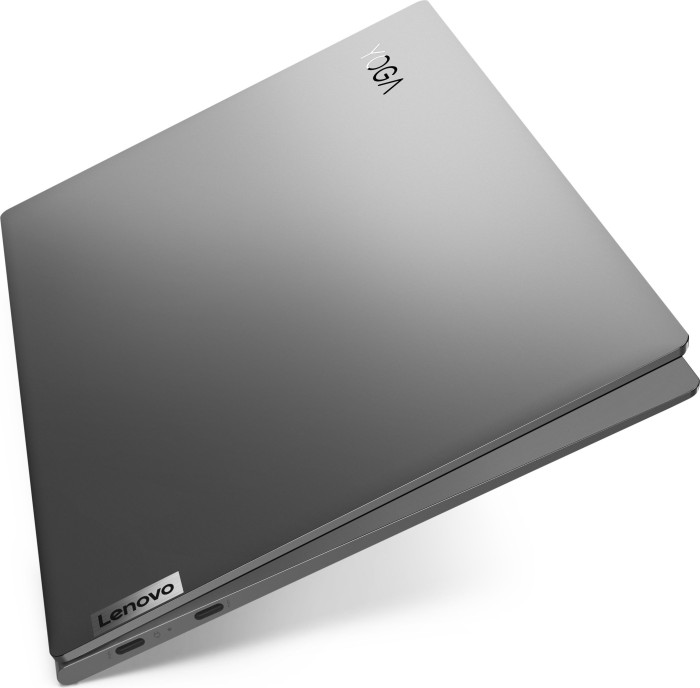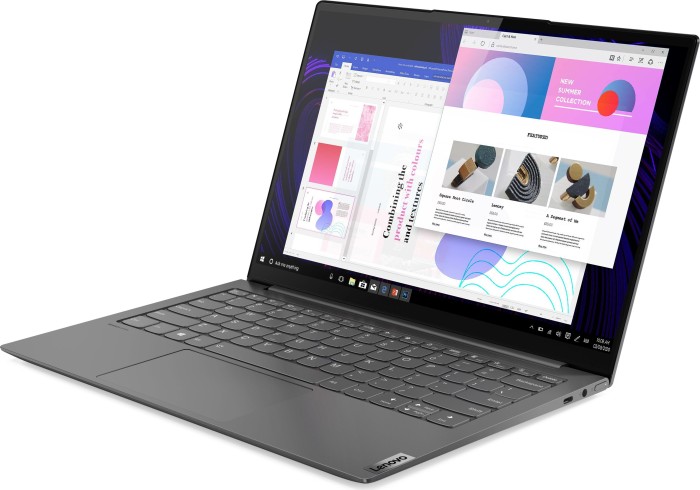




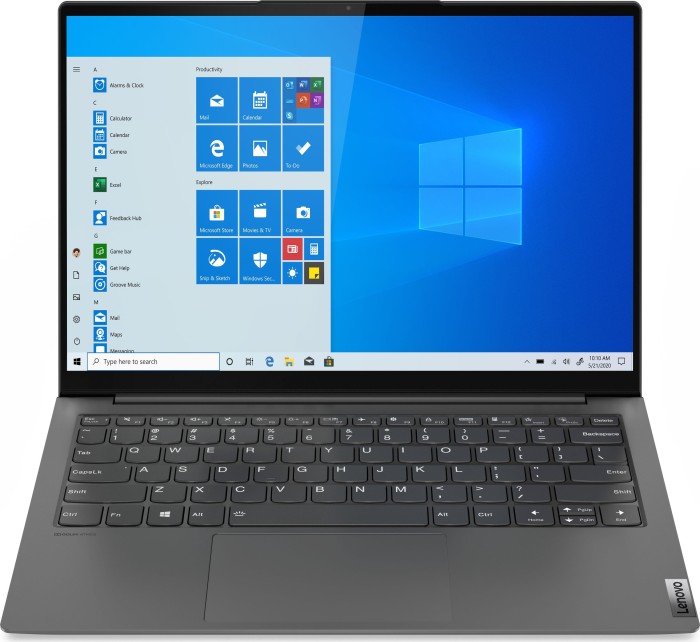
Lenovo Yoga Slim 7 13ITL5-82CU002JGE
Ausstattung / Datenblatt
Preisvergleich
Testberichte für das Lenovo Yoga Slim 7 13ITL5-82CU002JGE
Quelle: Laptop Media
 EN→DE Archive.org version
Lenovo promised a hassle-less, snappy experience with great performance. We are glad to say that they have managed to achieve it. Whether it is thanks to the Evo platform of Intel or not, we don’t care. What we do care about is that you get what you are promised and that this little machine can deliver exceptional performance both on the computational, and on the graphics side. It is such a bummer that you can’t make use of a populated I/O. Although the port selection doesn’t seem too bad with two Thunderbolt 4 connectors, and one additional USB Type-C port, this is pretty much all you get. Nevertheless, you get a dongle inside the box, which extends one of the Type-C ports to VGA, HDMI, and USB Type-A ports – not too shabby. Lenovo Yoga Slim 7i (13)’s IPS panel (B133QAN02.0) has a WQXGA resolution, comfortable viewing angles, and a very good contrast ratio. It boasts 96% sRGB coverage, and thankfully – it doesn’t use PWM.
Einzeltest, online verfügbar, Sehr Lang, Datum: 23.06.2021
Quelle: Pemmzchannel
 ID→DE Archive.org version
Positive: Slim size; light weight; high performance; long battery life; stylish design; powerful processor; high gaming performance.
Vergleich, online verfügbar, Mittel, Datum: 23.04.2022
Kommentar
Intel Iris Xe G7 80EUs: Integrierte Grafikkarte (in Tiger-Lake G4 SoCs) der Gen. 12 Architektur mit 80 EUs. Z.B. in Tiger Lake i5 CPUs verbaute iGPU.
Diese Klasse ist noch durchaus fähig neueste Spiele flüssig darzustellen, nur nicht mehr mit allen Details und in hohen Auflösungen. Besonders anspruchsvolle Spiele laufen nur in minimalen Detailstufen, wodurch die grafische Qualität oft deutlich leidet. Diese Klasse ist nur noch für Gelegenheitsspieler empfehlenswert. Der Stromverbrauch von modernen Grafikkarten in dieser Klasse ist dafür geringer und erlaubt auch bessere Akkulaufzeiten.
» Weitere Informationen gibt es in unserem Notebook-Grafikkartenvergleich und der Benchmarkliste.
i5-1135G7: Auf der Tiger-Lake-Architektur basierender ULV-SoC (System-on-a-Chip) für schlanke Notebooks und Ultrabooks. Integriert unter anderem vier CPU-Kerne mit 2,4 - 4,2 GHz und HyperThreading sowie eine starke G7 Grafikeinheit mit 80 Eus und wird in 10-Nanometer-Technik gefertigt (10nm+). » Weitere Infos gibt es in unserem Prozessorvergleich Vergleich mobiler Prozessoren und der Prozessoren Benchmarkliste .
 Als bevorzugte Quelle auf Google hinzufügen