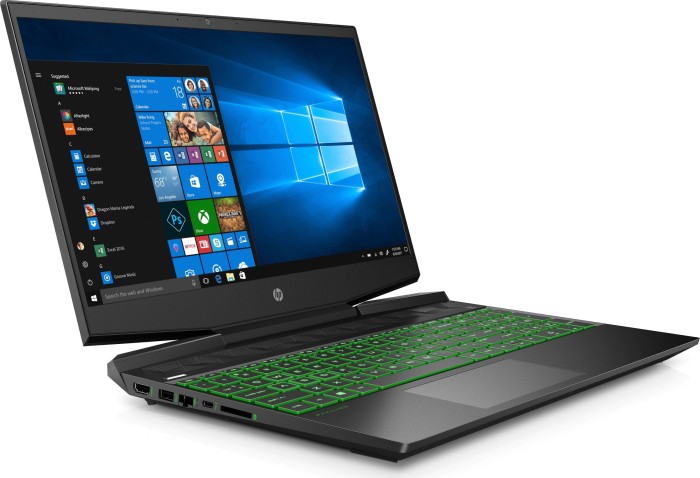




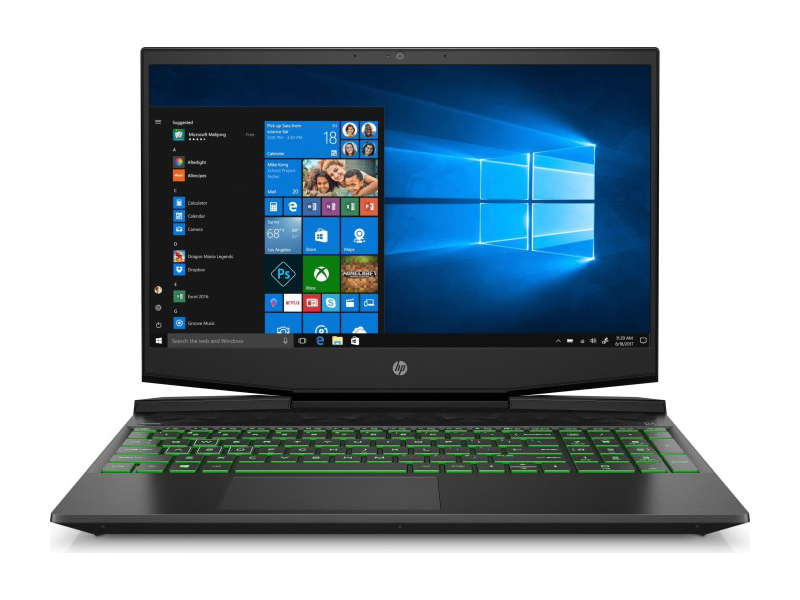
HP Pavilion Gaming 15-dk2070ng
Ausstattung / Datenblatt
Preisvergleich
Testberichte für das HP Pavilion Gaming 15-dk2070ng
Quelle: Laptop Media
 Archive.org version
Einzeltest, online verfügbar, Kurz, Datum: 02.05.2022
Quelle: Laptop Media
EN→DE Archive.org versionWhen it comes to the visuals, HP definitely takes a different approach from the rest of the field. Instead of the usual Black and Red combination, it pairs the dark color of the body with bright green surrounding the logo, and the same green color printed on the keyboard. However, the build quality is questionable, and we really want to see HP improving this device in 2022. Actually, this is one of the points where the laptop falls behind the competition in this segment. Thankfully, the battery life is decent with 8 hours of Web browsing, or 6 hours and a half of video playback. HP Pavilion Gaming 15 (15-dk2000)’s IPS panel (BOE080D) has a Full HD resolution, comfortable viewing angles, and a good contrast ratio. It also covers 90% of the sRGB color gamut. Unfortunately, it uses aggressive, low-frequency PWM for all brightness levels (except for the maximum). On the other hand, our Health-Guard profile completely resolves the issue. What it can’t do, however, is to make the pixel response time faster. Yep, this gaming laptop is equipped with a super slow panel.
Einzeltest, online verfügbar, Sehr Lang, Datum: 18.01.2022
Kommentar
NVIDIA GeForce RTX 3050 Ti Laptop GPU: Mobile Gaming-Grafikkarte die wahrscheinlich auf den GA107 Chip basiert. Bietet 2560 Kerne und Taktraten von bis zu 1695 MHz bei 80 Watt. Es sind jedoch viele Varianten erhältlich, bis 35 Watt und nur 1035 MHz Boost.
Diese Grafikkarten sollten alle modernen Spiele flüssig darstellen können. Anspruchsvolle Spiele müssen jedoch in mittlerer Detailstufe gespielt werden. Ältere und weniger anspruchsvolle Spiele wie die Sims Serie können auch in hohen Detailsstufen flüssig dargestellt werden.
» Weitere Informationen gibt es in unserem Notebook-Grafikkartenvergleich und der Benchmarkliste.
i7-11370H: Auf der Tiger-Lake-Architektur basierender ULV-SoC (System-on-a-Chip) für schlanke Notebooks und Ultrabooks. Integriert unter anderem vier CPU-Kerne mit 3 - 4,8 GHz und HyperThreading sowie eine starke G7 Grafikeinheit und wird in 10-Nanometer-Technik gefertigt (10nm SuperFin). » Weitere Infos gibt es in unserem Prozessorvergleich Vergleich mobiler Prozessoren und der Prozessoren Benchmarkliste .
 Als bevorzugte Quelle auf Google hinzufügen