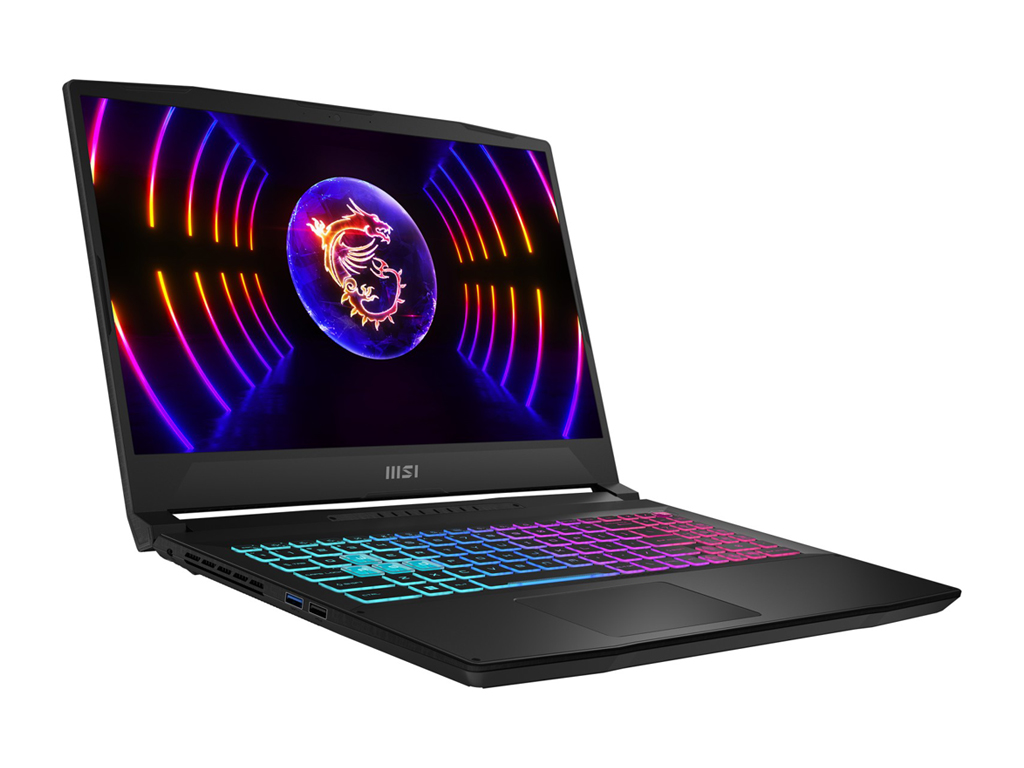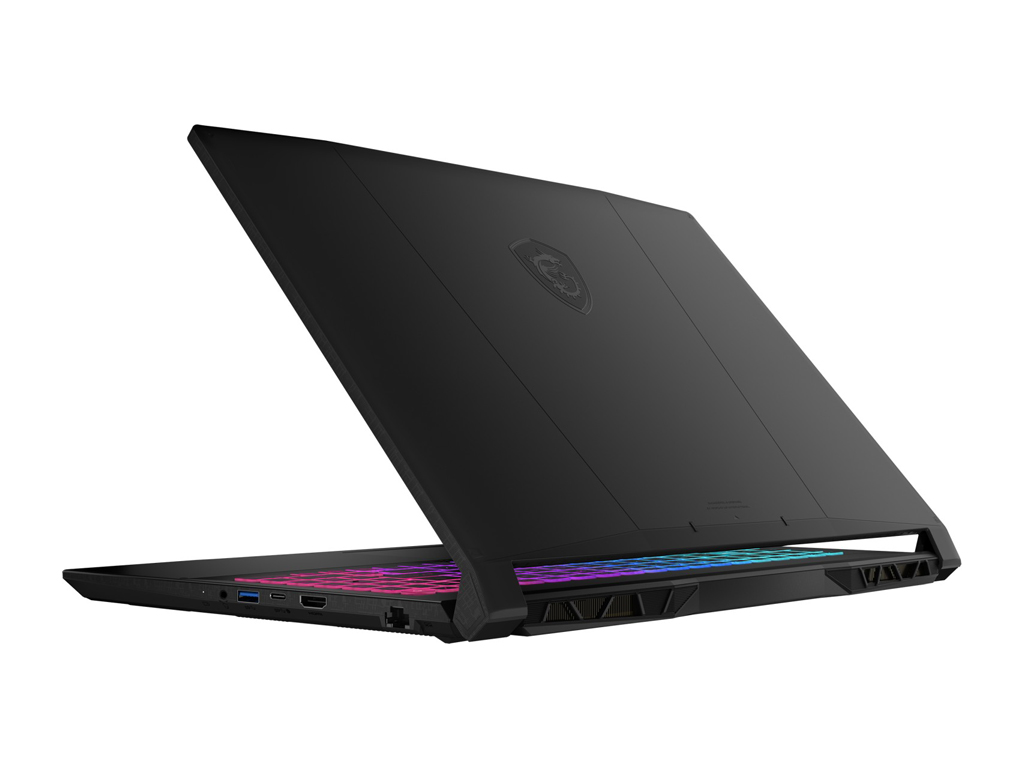




MSI Katana 17 B12VFK
Ausstattung / Datenblatt

Preisvergleich
Testberichte für das MSI Katana 17 B12VFK
Quelle: Laptop Media

Einzeltest, online verfügbar, Lang, Datum: 13.09.2023
Quelle: Laptop Media
EN→DEAs a gaming notebook in 2023, the Katana 17 (B12V) is fairly competitively priced. It offers wide configuration options based on capable GPUs from NVIDIA’s RTX 4000 roster. It’s worth mentioning that its RTX 4060 didn’t manage to fill its 105W TGP limit, but it ran pretty close with 85W detected by GPU-Z during full load. For all performance-based tests, we used the Extreme Performance preset through the MSI Center. Interestingly, there is a function that allows the use of a battery-saving display mode, which runs the screen at 60Hz. As a result, the device offers 6 hours and 30 minutes of Web browsing, or 5 hours and 30 minutes of video playback – about 50% better than the MSI Sword 17 (A12V), which lacks this function. MSI Katana 17 (B12V)’s IPS panel has a Full HD resolution, comfortable viewing angles, and good contrast. Unfortunately, it covers only 51% of the sRGB color gamut, and has slow pixel response times, despite the 144Hz refresh rate. On the bright side, the panel doesn’t use PWM for brightness adjustment.
Einzeltest, online verfügbar, Sehr Lang, Datum: 26.05.2023
Quelle: Laptop Media
Support, online verfügbar, Sehr kurz, Datum: 26.05.2023
Kommentar
Modell: MSI Katana 17 B12VGK jetzt bei Amazon
NVIDIA GeForce RTX 4060 Laptop GPU: High-End-Notebookgrafikkarte basierend auf die Ada Lovelace Architektur. Bietet 8 GB GDDR6 VRAM (128 Bit) und ca 35-115W TGP (+ Dynamic Boost).
Diese Grafikkarten sollten alle modernen Spiele flüssig darstellen können. Anspruchsvolle Spiele müssen jedoch in mittlerer Detailstufe gespielt werden. Ältere und weniger anspruchsvolle Spiele wie die Sims Serie können auch in hohen Detailsstufen flüssig dargestellt werden.
» Weitere Informationen gibt es in unserem Notebook-Grafikkartenvergleich und der Benchmarkliste.
i7-12650H: Auf der Alder-Lake-Architektur basierender High-End Mobilprozessor. Bietet 6 Performance-Kerne und 4 Effizienzkerne und kann 16 Threads gleichzeitig bearbeiten. Der maximale Turbo-Takt der P-Kerne beträgt 4,7 GHz. » Weitere Infos gibt es in unserem Prozessorvergleich Vergleich mobiler Prozessoren und der Prozessoren Benchmarkliste .
 Als bevorzugte Quelle auf Google hinzufügen