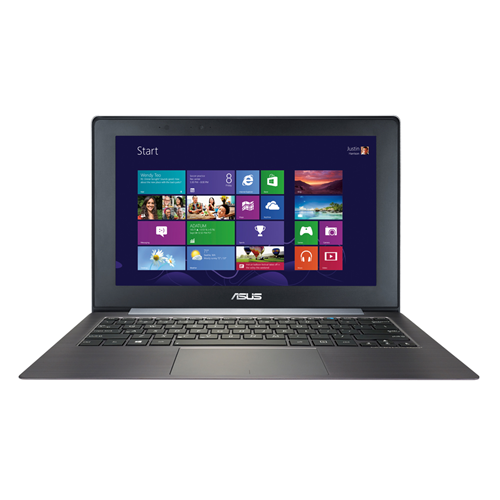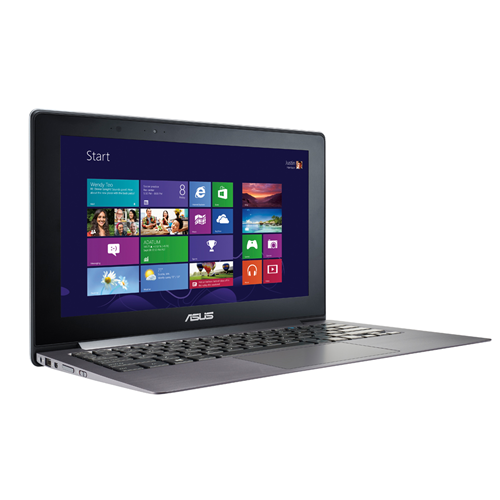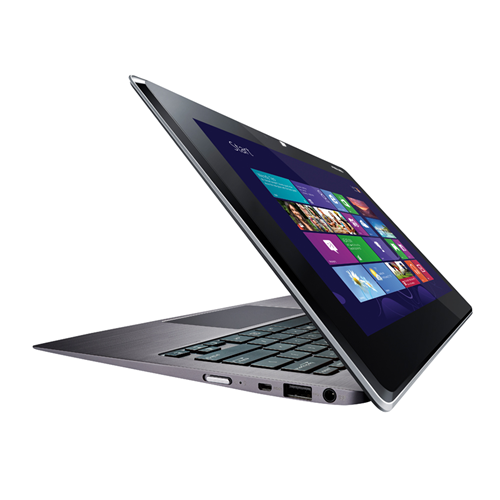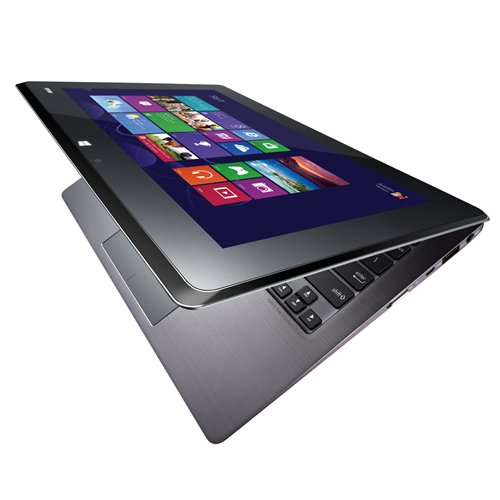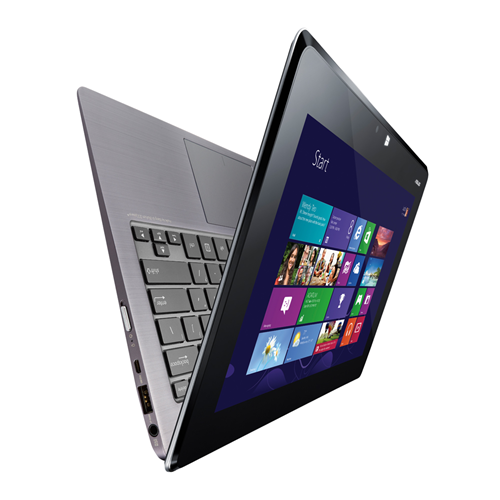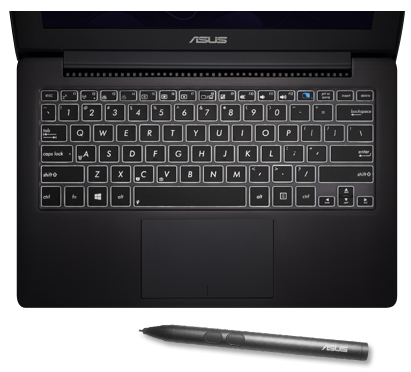




Asus Taichi 21-CW002H
Ausstattung / Datenblatt
Preisvergleich
Durchschnitt von 3 Bewertungen (aus 6 Tests)
Testberichte für das Asus Taichi 21-CW002H
Quelle: Chip.de
 Archive.org version
Das hochwertig verarbeitete Asus Taichi21-CW002H sieht zwar interessant aus, das Dual-Konzept überzeugt aber weder als Ultrabook noch als Tablet zur Gänze: Die Laufzeit ist zu kurz, die Display-Qualität bestenfalls befriedigend und die gefühlte Wärmeentwicklung zu hoch. Zu dem hohen Preis holen Sie sich besser ein gutes Ultrabook und ein gutes Tablet dazu.
Einzeltest, online verfügbar, Mittel, Datum: 05.02.2013
Bewertung: Gesamt: 78% Preis: 63% Leistung: 75% Ausstattung: 66% Bildschirm: 89% Mobilität: 71% Ergonomie: 88%
Quelle: Notebookjournal
Archive.org versionDie Idee von Asus, zwei Bildschirme in einem Gerät zu verbauen ist mutig. Aber geht das Konzept in der Praxis auf? Für Präsentationen, bei denen man sich gegenübersitzt, sind die Bildschirme mit 11,6 Zoll zu klein. Hier sollte man vielleicht auf das 13-Zoll-Modell warten, das in Kürze folgen soll. Das löst aber auch ein anderes Problem nicht: Normalerweise sieht man beim Notebook auf ein leicht nach hinten gekipptes Display.
Einzeltest, online verfügbar, Lang, Datum: 18.01.2013
Bewertung: Leistung: 70% Ausstattung: 30% Bildschirm: 70% Mobilität: 40% Gehäuse: 70% Ergonomie: 20%
Ausländische Testberichte
Quelle: PC Authority
 EN→DE Archive.org version
Many manufacturers are struggling to find the most natural meeting point between the tablet and the laptop, and Asus’ own Windows 8 range provides yet more evidence of this. With its VivoBooks marrying touchscreens to standard laptops, the forthcoming VivoTab range mimicking the separate tablet and keyboard dock concept of the Android-powered Transformer Pad, and the Taichi 21 ploughing its own dual-screened furrow, it seems even Asus isn’t confident enough to put all of its eggs in one basket. Give it a few years and a refined, lighter chassis married with more power-efficient CPUs and improved battery life could see this dual-screened form factor present a compelling hybrid. At present, though, Asus’ Taichi 21 feels like a bold, innovative concept that’s just a little too far ahead of its time.
Einzeltest, online verfügbar, Kurz, Datum: 19.02.2013
Bewertung: Gesamt: 67%
Quelle: Ultrabook News
EN→DE Archive.org versionASUS deserves applause for trying something new and doing it as well as is possible given the current technology. It’s a flagship product that’s brought ASUS a lot of well- deserved attention but we don’t think it’s going to sell that well. It’s simply ahead of its time. Ivy Bridge is not a consumer tablet-capable processor and sandwiching two 1080p screens comes with big size and battery life trade-offs. The Taichi 21 needs to be 20% lighter with 50% better battery life. Interestingly that could be only one generation away. Haswell could make products like this into highly dynamic and usable devices that span consumer and business use.
Einzeltest, online verfügbar, Lang, Datum: 11.02.2013
Quelle: Engadget
EN→DE Archive.org versionAround the time I wrote this review, I was also working on Engadget's first-ever laptop buyer's guide. I was sure the TAICHI would be a shoo-in for the convertible section, what with its innovative design and sterling spec sheet. Unfortunately, as inventive as this is as a concept, the finished product isn't quite what we all thought it would be.
Einzeltest, online verfügbar, Lang, Datum: 06.02.2013
Quelle: Good Gear Guide
EN→DE Archive.org versionThe ASUS Taichi 21 is a hybrid Ultrabook that ships with two Full HD screens. Open the lid to use it as a laptop, close the lid to use it as a tablet. It's easy to use and it provides a very good tablet experience. It's not perfect though: we think it needs some tweaks to the hardware and software. But overall, it's a unit worth considering if you're after a Windows 8 hybrid unit.
Einzeltest, online verfügbar, Mittel, Datum: 19.11.2012
Bewertung: Gesamt: 75%
Kommentar
Intel HD Graphics 4000: In Ivy Bridge Prozessoren (3. Generation Core) integrierte Grafikkarte in höchster Ausbaustufe. Je nach Prozessor (ULV bis Desktop Quad-Core) unterschiedlich getaktet.
Einige nicht anspruchsvolle aktuelle Spiele können mit geringen Details noch flüssig gespielt werden. Für Office und Video natürlich ausreichende Leistungsreserven.
» Weitere Informationen gibt es in unserem Notebook-Grafikkartenvergleich und der Benchmarkliste.
3317U:
Stromspar-Doppelkernprozessor mit nur 1.7 GHz Basisfrequenz aber einem Turbo bis zu 2.6 GHz (bei ausreichender Kühlung). Integriert die Intel HD Graphics 4000 (jedoch nur mit 350 - 1050 MHz Taktung) und einen DDR3-1600 Speicherkontroller.
» Weitere Infos gibt es in unserem Prozessorvergleich Vergleich mobiler Prozessoren und der Prozessoren Benchmarkliste .
 Als bevorzugte Quelle auf Google hinzufügen