



Notebookcheck Logo

Intel Celeron N2810

Intel N2810

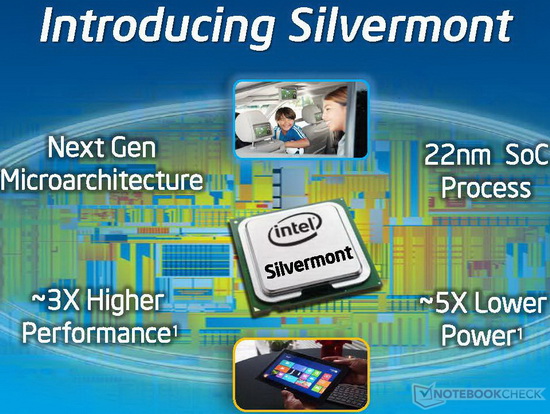
Der Intel Celeron N2810 ist ein sparsamer Dual-Core-SoC aus dem Einstiegssegment. Er taktet mit bis zu 2,0 GHz und gehört der Bay Trail-M Plattform an. Dank eines speziell für Low-Power-Chips optimierten 22-Nanometer-Prozesses (P1271) mit Tri-Gate-Transistoren konnte die Performance sowie die Energieeffizienz gegenüber dem Vorgänger deutlich gesteigert werden.

Architektur

Die Prozessorkerne basieren auf der neuen Silvermont-Architektur, welche erstmals bei einem Atom-Prozessor als Out-of-order-Design ausgeführt wurde. Die dadurch erhöhte Auslastung der Pipeline sowie viele weitere Detailverbesserungen (optimierte Sprungvorhersage, vergrößerte Buffer, verbesserte Decoder) sollen die Pro-MHz-Leistung um etwa 50 Prozent steigern. Gleichzeitig entfällt allerdings das Hyper-Threading-Feature der Vorgängermodelle. Weitere wichtige Änderungen umfassen die Unterstützung neuer Befehlssatzerweiterungen wie SSE 4.1 und 4.2 sowie AES-NI (modellabhängig).

Performance

Dank der verbesserten Mikroarchitektur übertrifft die Performance bisherige Atom-Modelle wie den Z2760 deutlich. Damit liegt der Celeron N2810 in Schlagdistanz zu AMD-APUs wie dem AMD A4-4355M, sodass ausreichende Leistungsreserven für einfache Office- und Multimedia-Anwendungen bestehen. Anspruchsvollere Software wird den Einstiegs-SoCs hingegen sehr schnell überfordern.

Grafik

Die HD Graphics (Bay Trail) basiert auf Intels-Gen7-Architektur, welche DirectX 11 unterstützt und auch bei den Grafiklösungen der Ivy-Bridge-Serie (z.B. HD Graphics 4000) zum Einsatz kommt. Mit nur 4 EUs und maximal 756 MHz Taktrate fällt die Leistung aber noch deutlich niedriger als bei der HD Graphics (Ivy Bridge) aus, sodass nur ältere und weniger anspruchsvolle Windows-Spiele flüssig dargestellt werden. Obwohl selbst dies ein drastischer Fortschritt gegenüber dem Vorgänger ist, reicht die GPU-Performance nicht an konkurrierende AMD-APUs (mit allerdings zumeist höherer TDP) heran.

Leistungsaufnahme

Der gesamte SoC wird von Intel mit einer TDP von 7,5 Watt spezifiziert, sodass der Chip auch in sehr kompakten Subnotebooks oder Tablets eingesetzt werden kann. Bei typischer Nutzung soll die Leistungsaufnahme bei nur 4,5 Watt liegen (SDP).

CodenameBay Trail-M
SerieIntel Celeron

Serie: Celeron Bay Trail-M

Intel Celeron N2930 compare1.83 - 2.16 GHz4 / 4 cores
Intel Celeron N2920 compare1.86 - 2 GHz4 / 4 cores
Intel Celeron N2940 compare1.83 - 2.25 GHz4 / 4 cores
Intel Celeron N2910 compare1.6 GHz4 / 4 cores
Intel Celeron N2840 compare2.16 - 2.58 GHz2 / 2 cores
Intel Celeron N2820 compare2.17 - 2.39 GHz2 / 2 cores
Intel Celeron N2830 compare2.16 - 2.41 GHz2 / 2 cores
Intel Celeron N2810 « 2 GHz2 / 2 cores
Intel Celeron N2815 compare1.86 - 2.13 GHz2 / 2 cores
Intel Celeron N2807 compare1.58 - 2.16 GHz2 / 2 cores
Intel Celeron N2808 compare1.58 - 2.25 GHz2 / 2 cores
Intel Celeron N2806 compare1.58 - 2 GHz2 / 2 cores
Intel Celeron N2805 compare1.46 GHz2 / 2 cores
Taktung2000 MHz
Level 1 Cache112 KB
Level 2 Cache1 MB
Anzahl von Kernen / Threads2 / 2
Stromverbrauch (TDP = Thermal Design Power)7.5 Watt
Herstellungstechnologie22 nm
FeaturesHD Graphics (Bay Trail, max. 756 MHz)
GPUIntel HD Graphics (Bay Trail) (313 - 756 MHz)
64 Bit64 Bit wird unterstützt
Architecturex86
Vorgestellt am11.09.2013
Produktinformationen beim Herstellerark.intel.com

Benchmarks

Cinebench R15 - Cinebench R15 CPU Multi 64 Bit
59 Points (0%)
Suchen: Modell: Max. Alter: Jahre
Cinebench R15 - Cinebench R15 CPU Single 64 Bit
31 Points (9%)
Suchen: Modell: Max. Alter: Jahre
Cinebench R11.5 - Cinebench R11.5 CPU Multi 64 Bit
0.7 Points (1%)
Cinebench R11.5 - Cinebench R11.5 CPU Single 64 Bit
0.4 Points (9%)
Cinebench R10 - Cinebench R10 Rend. Single (32bit)
993 Punkte (6%)
Cinebench R10 - Cinebench R10 Rend. Multi (32bit)
1474 Punkte (1%)
Cinebench R10 - Cinebench R10 Rend. Multi (64bit)
2672 Points (2%)
Cinebench R10 - Cinebench R10 Rend. Single (64bit)
1318 Points (2%)
wPrime 2.10 - wPrime 2.0 1024m *
1941 s (23%)
wPrime 2.10 - wPrime 2.0 32m *
63.4 s (13%)
WinRAR - WinRAR 4.0
680 Punkte (1%)
X264 HD Benchmark 4.0 - x264 Pass 2
4.3 fps (0%)
X264 HD Benchmark 4.0 - x264 Pass 1
22.8 fps (1%)
TrueCrypt - TrueCrypt Serpent
0.1 GB/s (2%)
TrueCrypt - TrueCrypt Twofish
0.1 GB/s (1%)
TrueCrypt - TrueCrypt AES
0.1 GB/s (0%)
3DMark 06 - CPU - 3DMark 06 - CPU
1043 Points (2%)
Super Pi mod 1.5 XS 1M - Super Pi mod 1.5 XS 1M *
43 s (9%)
Super Pi mod 1.5 XS 2M - Super Pi mod 1.5 XS 2M *
93.9 s (4%)
Super Pi Mod 1.5 XS 32M - Super Pi mod 1.5 XS 32M *
1999 s (9%)
3DMark Vantage - 3DM Vant. Perf. CPU no Physx
2038 Points (2%)
3DMark 11 - 3DM11 Performance Physics
858 Points (2%)
3DMark - 3DMark Ice Storm Physics
9157 Points (7%)
3DMark - 3DMark Cloud Gate Physics
710 Points (2%)
3DMark - 3DMark Fire Strike Standard Physics
969 Points (2%)
Geekbench 3 - Geekbench 3 32 Bit Multi-Core
1328 Punkte (2%)
Geekbench 3 - Geekbench 3 32 Bit Single-Core
762 Punkte (10%)
Geekbench 2 - 32 Bit - Geekbench Stream
2192 Points (12%)
Geekbench 2 - 32 Bit - Geekbench Memory
2027 Points (14%)
Geekbench 2 - 32 Bit - Geekbench Floating Point
1715 Points (3%)
Geekbench 2 - 32 Bit - Geekbench Integer
1924 Points (4%)
Geekbench 2 - 32 Bit - Geekbench Total Score
1898 Points (5%)
- Bereich der Benchmarkergebnisse
red legend - Durchschnittliche Benchmarkergebnisse

* Kleinere Werte sind besser

Amazon Logo
  • $259.99
    ASUS 15.6” FHD Laptop - Intel Celeron N4020-4GB Memory - 128GB Storage - Windows 11 Home in S Mode - Star Black - L510MA-TH04
  • $152.99
    ASUS 14" FHD Laptop, Intel Celeron N4500 Processor, 4GB RAM, 64GB eMMC, Intel Iris Xe Graphics, 720P Camera, Bluetooth, Win 11 S, Quiet Blue (Renewed)
  • $238.00
    Acer 14" Notebook, Intel Celeron N3050 1.60 GHz, 2 GB Ram,32 GB Flash,Windows 10 (Renewed)
  • $232.87
    Gateway 14.1" Ultra Slim Notebook, FHD, Intel Celeron, Dual Core, 4GB/64GB, Tuned by THX Audio, Mini HDMI, Cortana, 1MP Webcam, Windows 10 S, Microsoft 365 Personal 1-Year Included, Blue

Ein oder mehrere Geräte zum Vergleich auswählen

In der folgenden Liste können sie Geräte suchen und für einen Vergleich auswählen.

Modell suchen:
v1.35
log 13. 00:42:40

#0 ran 0s before starting gpusingle class +0s ... 0s

#1 no ids found in url (should be separated by "_") +0s ... 0s

#2 not redirecting to Ajax server +0s ... 0s

#3 did not recreate cache, as it is less than 5 days old! Created at Tue, 10 Mar 2026 11:03:36 +0100 +0.002s ... 0.002s

#4 composed specs +0.017s ... 0.019s

#5 did output specs +0s ... 0.019s

#6 getting avg benchmarks for device 4577 +0.005s ... 0.024s

#7 got single benchmarks 4577 +0.01s ... 0.034s

#8 got avg benchmarks for devices +0s ... 0.034s

#9 min, max, avg, median took s +1.521s ... 1.556s

#10 return log +0.544s ... 2.099s

Testberichte für den Intel Celeron N2810 Prozessor


Test Toshiba Satellite NB10t-A-101 Netbook

Sparsamer Leisetreter. Ein Netbook im 11,6-Zoll-Format hält Toshiba mit dem neuen Satellite NB10t-A-101 bereit. Zur Ausstattung zählen u.a. ein Bay-Trail-Celeron, ein Touchscreen, eine 500-GB-fassende Festplatte sowie Windows 8. Für das Gerät werden etwa 380 Euro fällig. Ob Toshibas kleines Netbook zu gefallen weiß, verrät unser Testbericht.
Intel Celeron N2810, HD Graphics (Bay Trail), 11.6", 1.5 kg

Toshiba Satellite Pro NB10-A-109: Intel HD Graphics (Bay Trail), 11.60", 1.5 kg
  Externer Test » Toshiba Satellite Pro NB10-A-109

Toshiba Satellite NB10t-A-101: Intel HD Graphics (Bay Trail), 11.60", 1.5 kg
  Externer Test » Toshiba Satellite NB10t-A-101

Toshiba Satellite NB10t-A-103: Intel HD Graphics (Haswell), 11.60", 1.3 kg
  Externer Test » Toshiba Satellite NB10t-A-103

Toshiba Satellite NB15t-A1304: Intel HD Graphics (Bay Trail), 11.60", 1.5 kg
  Externer Test » Toshiba Satellite NB15t-A1304

Toshiba Satellite NB15T-A1302: Intel HD Graphics (Bay Trail), 11.60", 1.5 kg
  Externer Test » Toshiba Satellite NB15T-A1302

Teilen Sie diesen Artikel, um uns zu unterstützen. Jeder Link hilft!
Mail Logo

» Vergleich mobiler Prozessoren
Alle CPU Serien für Notebooks mit kurzer Beschreibung

» Mobile Prozessoren - Benchmarkliste
Sortier- und filterbare Benchmark-Liste

Prozessoren der Serie Celeron

» Intel Celeron 3765U
   2x 1.9 GHz
» Intel Celeron 3755U
   2x 1.7 GHz
» Intel Celeron 3215U
   2x 1.7 GHz
» Intel Celeron B810
   2x 1.6 GHz
» Intel Celeron 1000M
   2x 1.8 GHz
» Intel Celeron 1037U
   2x 1.8 GHz
» Intel Celeron 2950M
   2x 2 GHz
» Intel Celeron J3455
   4x 1.5 GHz - 2.3 GHz
» Intel Celeron N3450
   4x 1.1 GHz - 2.2 GHz
» Intel Celeron B815
   2x 1.6 GHz
» Intel Celeron 1020E
   2x 2.2 GHz
» Intel Celeron 887
   2x 1.5 GHz
» Intel Celeron 4205U
   2x 1.8 GHz
» Intel Celeron 2981U
   2x 1.6 GHz
» Intel Celeron 1005M
   2x 1.9 GHz
» Intel Celeron 1020M
   2x 2.1 GHz
» Intel Celeron 2980U
   2x 1.6 GHz
» Intel Celeron 1017U
   2x 1.6 GHz
» Intel Celeron N3160
   4x 1.6 GHz - 2.24 GHz
» Intel Celeron N2930
   4x 1.83 GHz - 2.16 GHz
» Intel Celeron N3150
   4x 1.6 GHz - 2.08 GHz
» Intel Celeron B830
   2x 1.8 GHz
» Intel Celeron 3205U
   2x 1.5 GHz
» Intel Celeron 2955U
   2x 1.4 GHz
» Intel Celeron N2920
   4x 1.86 GHz - 2 GHz
» Intel Celeron B840
   2x 1.9 GHz
» Intel Celeron N2940
   4x 1.83 GHz - 2.25 GHz
» Intel Celeron J3355
   2x 2 GHz - 2.5 GHz
» Intel Celeron 2970M
   2x 2.2 GHz
» Intel Celeron 1019Y
   2x 1 GHz
» Intel Celeron B820
   2x 1.7 GHz
» Intel Celeron B710
   1x 1.6 GHz
» Intel Celeron N2910
   4x 1.6 GHz
» Intel Celeron N3350
   2x 1.1 GHz - 2.4 GHz
» Intel Celeron 2957U
   2x 1.4 GHz
» Intel Celeron 1007U
   2x 1.5 GHz
» Intel Celeron B800
   2x 1.5 GHz
» Intel Celeron 847
   2x 1.1 GHz
» Intel Celeron J1900
   4x 2 GHz - 2.42 GHz
» Intel Celeron 2961Y
   2x 1.1 GHz
» Intel Celeron 1047UE
   2x 1.4 GHz
» Intel Celeron 807
   1x 1.5 GHz
» Intel Celeron N3060
   2x 1.6 GHz - 2.48 GHz
» Intel Celeron 877
   2x 1.4 GHz
» Intel Celeron N2840
   2x 2.16 GHz - 2.58 GHz
» Intel Celeron N2820
   2x 2.17 GHz - 2.39 GHz
» Intel Celeron B730
   1x 1.8 GHz
» Intel Celeron B720
   1x 1.7 GHz
» Intel Celeron N2830
   2x 2.16 GHz - 2.41 GHz
» Intel Celeron N3050
   2x 1.6 GHz - 2.16 GHz
» Intel Celeron J1850
   4x 2 GHz
» Intel Celeron J1800
   2x 2.41 GHz - 2.58 GHz
» Intel Celeron 867
   2x 1.3 GHz
» Intel Celeron N2810
   2x 2 GHz
» Intel Celeron N2815
   2x 1.86 GHz - 2.13 GHz
» Intel Celeron N2807
   2x 1.58 GHz - 2.16 GHz
» Intel Celeron N3000
   2x 1.04 GHz - 2.08 GHz
» Intel Celeron N2808
   2x 1.58 GHz - 2.25 GHz
» Intel Celeron N2806
   2x 1.58 GHz - 2 GHz
» Intel Celeron J1750
   2x 2.41 GHz
» Intel Celeron N2805
   2x 1.46 GHz
» Intel Celeron 927UE
   1x 1.5 GHz
» Intel Celeron 797
   1x 1.4 GHz

Ähnlich schnelle CPUs

+ Intel Celeron 867
   2x 1.3 GHz
+ AMD V-Series V160
   1x 2.4 GHz
+ AMD Athlon X2 QL-66
   2x 2.2 GHz
+ Intel Celeron M 743
   1x 1.3 GHz
+ Intel Core 2 Duo T5200
   2x 1.66 GHz
» Intel Celeron N2810
   2x 2 GHz
- Intel Pentium 977
   2x 1.4 GHz
- AMD Athlon X2 QL-64
   2x 2.1 GHz
- Intel Celeron 3867U
   2x 1.8 GHz
- Intel Pentium U5600
   2x 1.33 GHz
- AMD C-50
   2x 1 GHz
Autor: Klaus Hinum (Update:  8.01.2026)